





Manufacturing Process Planning: Step-by-Step Guide for Engineers
September 10, 2026 2026-09-10 14:20Manufacturing Process Planning: Step-by-Step Guide for Engineers

Manufacturing Process Planning: Step-by-Step Guide for Engineers
Most manufacturing problems don’t start on the shop floor—they start much earlier, during manufacturing process planning. When the process isn’t clearly defined, even the best machines and skilled operators struggle to deliver consistent results, leading to delays, rework, and increased costs.
In modern manufacturing, success depends not just on what you produce, but on how well you plan the production. Without a structured manufacturing planning approach, operations can quickly become inefficient, with poor coordination between design, materials, and execution.
Manufacturing process planning solves this by turning product designs into clear, step-by-step production instructions. It defines how a product will be made, what resources are needed, and how to ensure efficiency, quality, and on-time delivery across the entire production cycle.
Table of Contents
What is Manufacturing Process Planning?
Manufacturing Process Planning (MPP) is the process of defining how a product will be manufactured before production begins. It converts engineering designs into clear, step-by-step instructions for the shop floor.
In simple terms:
- Design answers → What to build?
- Manufacturing process planning answers → How to build it?
A well-defined manufacturing process plan typically includes:
- Selection of manufacturing processes (casting, machining, etc.)
- Sequence of operations (routing)
- Machines and equipment required
- Tools, fixtures, and raw materials
- Workforce requirements
- Quality inspection checkpoints
- Estimated production time and cost
This ensures production is efficient, consistent, and cost-effective, while meeting quality and delivery requirements.
Why Manufacturing Planning Matters
Without proper manufacturing planning, companies often face:
- Production delays and missed deadlines
- Increased rework and material waste
- Poor product quality
- Inefficient use of machines and labor
- Higher manufacturing costs
Key Benefits of Manufacturing Planning
Effective manufacturing planning offers numerous advantages:
Clear work instructions reduce confusion and enable operators to complete tasks more efficiently.
- Reduced Manufacturing Costs
Optimized routing, minimized idle time, and efficient resource allocation lower production expenses.
- Better Product Quality
Quality checkpoints throughout the manufacturing process help identify defects early, reducing rework and scrap.
- Faster Production
Optimized scheduling minimizes downtime and shortens production cycles.
- Efficient Resource Utilization
Machines, labour, materials, and tools are allocated effectively, maximizing operational efficiency.
- Better Customer Satisfaction
Reliable production schedules improve on-time delivery and strengthen customer trust.
- Easier Scalability
Well-documented manufacturing processes make it easier to increase production capacity when demand grows.
Example: Planning Makes the Difference
Company A: Starts production without a proper plan
- Faces delays, rework, and higher costs
Company B: Uses a well-defined manufacturing process plan
- Follows optimized operations, planned inspections, and proper scheduling
- Achieves better quality with lower costs and timely delivery
The difference isn’t the machines—it’s the planning behind the production.
Difference Between Manufacturing Process Planning and Production Planning
Although often used interchangeably, manufacturing process planning and production planning serve different purposes in manufacturing.
| Aspect | Manufacturing Process Planning | Production Planning |
|---|---|---|
|
Focus |
How the product will be made |
When and how much to produce |
|
Purpose |
Define manufacturing methods and operations |
Plan schedules, quantities, and resources |
|
Scope |
Technical (processes, machines, tools) |
Operational (time, capacity, workforce) |
|
Key Decisions |
Process selection, routing, tools, quality checks |
Scheduling, inventory, resource allocation |
|
Stage |
Before production begins |
During planning and execution of production |
As defined earlier, Manufacturing Process Planning focuses on how a product will be made, while Production Planning focuses on when and how much to produce.
What is the Production Planning Process?
One of the most frequently asked questions in manufacturing is, “What is the production planning process?”
The production planning process is a structured sequence of activities that ensures products are manufactured efficiently while meeting customer requirements, quality standards, and delivery schedules. Although the exact workflow may vary across industries, the core steps remain largely the same.
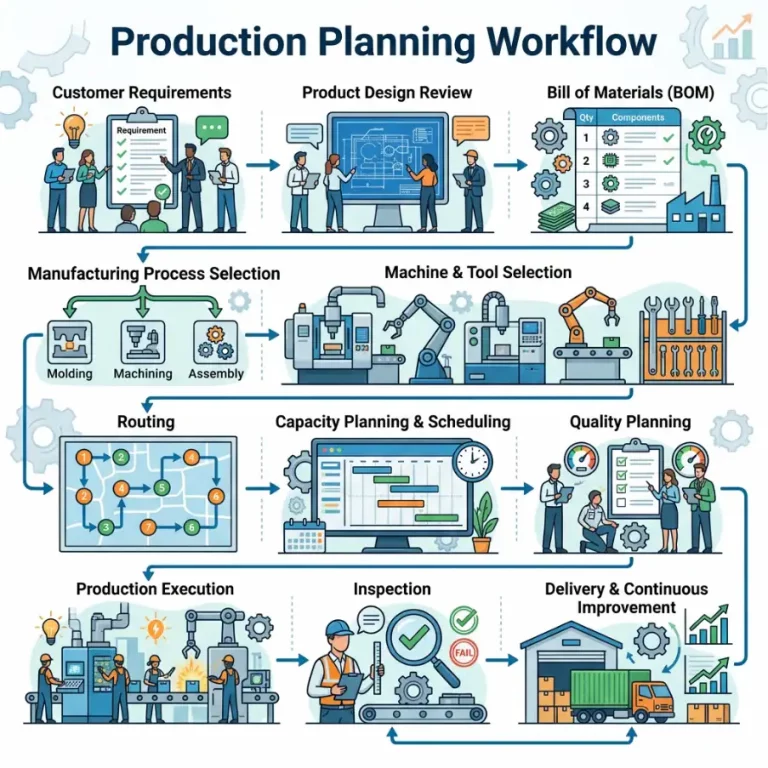
Step 1: Understand Customer Requirements
Every manufacturing project begins by understanding customer expectations.
Manufacturers analyse:
- Product specifications
- Required quantities
- Delivery deadlines
- Industry standards
- Regulatory requirements
- Cost targets
A well-defined understanding of these requirements helps avoid delays, reduces rework, and ensures smoother production execution.
Step 2: Review Product Design
Engineering teams evaluate CAD models and technical drawings to determine manufacturability.
They assess:
- Dimensions and tolerances
- Material specifications
- Assembly requirements
- Critical features
- Design complexity
If necessary, Design for Manufacturing (DFM) principles are applied to simplify production without affecting functionality.
Step 3: Bill of Materials (BOM) Planning
A Bill of Materials (BOM) lists every component required to manufacture the product.
This includes:
- Raw materials
- Standard parts
- Fasteners
- Purchased components
- Consumables
Accurate BOM planning helps avoid inventory shortages and unnecessary procurement costs.
Step 4: Select Manufacturing Processes
The next step is choosing the most suitable manufacturing methods.
Common manufacturing processes include:
- Casting
- Forging
- Machining
- Milling
- Turning
- Welding
- Sheet metal fabrication
- Injection moulding
- Additive manufacturing (3D printing)
- Heat treatment
- Surface finishing
Process selection depends on material, geometry, production volume, quality requirements, and cost considerations.
Step 5: Machine and Tool Selection
Manufacturing planners determine:
- CNC machines
- Conventional machines
- Cutting tools
- Fixtures
- Jigs
- Measuring equipment
Proper equipment selection improves machining accuracy, production speed, and operational efficiency.
Step 6: Process Routing
Routing defines the exact sequence of manufacturing operations.
For example:
- Raw material preparation
- Rough machining
- Heat treatment
- Finish machining
- Drilling
- Surface finishing
- Inspection
- Assembly
- Packaging
Optimized routing minimizes unnecessary movement and improves workflow.
Step 7: Capacity Planning and Scheduling
Production managers evaluate:
- Machine availability
- Workforce availability
- Production capacity
- Shift planning
- Delivery commitments
Scheduling ensures the right resources are available at the right time, reducing bottlenecks and maximizing throughput.
Step 8: Quality Planning
Quality control isn’t limited to final inspection.
Inspection checkpoints are strategically placed throughout production to verify dimensions, tolerances, and process capability. Early defect detection significantly reduces scrap and rework costs.
Step 9: Production Execution and Continuous Improvement
Once planning is complete, production begins.
Modern manufacturers continuously monitor:
- Machine performance
- Production rates
- Downtime
- Scrap rates
- Equipment utilization
- Product quality
The collected data helps identify improvement opportunities and refine future manufacturing plans, creating a cycle of continuous improvement.
How to Create a Manufacturing Plan
While the production planning process provides a detailed workflow, the following framework offers a simplified view of how engineers build a manufacturing plan in practice.
1. Define Product and Customer Requirements
Every manufacturing plan begins with a clear understanding of the product and customer expectations.
Manufacturers review:
- Technical drawings and specifications
- Production volumes
- Quality standards
- Delivery timelines
- Regulatory requirements
For example, manufacturing a medical device requires strict compliance and quality control, while consumer products may prioritize speed and cost efficiency.
2. Analyse Product Design
Before production begins, engineers evaluate whether the design can be manufactured efficiently.
This stage often involves Design for Manufacturing (DFM).
Key questions include:
- Can the part be manufactured using standard machining tools?
- Are the specified tolerances practical?
- Can the number of operations be reduced?
- Is there a more cost-effective manufacturing method?
Addressing these early helps avoid costly changes during production.
3. Select the Manufacturing Processes
The choice of manufacturing process depends on:
- Material type
- Product geometry
- Production volume
- Required surface finish
- Dimensional accuracy
- Cost constraints
| Product | Suitable Manufacturing Process |
|---|---|
|
Engine block |
Casting + CNC machining |
|
Bicycle frame |
Tube bending + Welding |
|
Smartphone casing |
CNC machining (prototypes/premium) or
die casting (high volume) |
|
Plastic bottle |
Injection moulding |
|
Aerospace bracket |
Additive manufacturing + Finish machining |
Selecting the right process ensures both quality and cost efficiency.
4. Plan Resources
Resource planning includes identifying:
- Machines and equipment
- Cutting tools
- Fixtures and jigs
- Operators and technicians
- Inspection equipment
- Raw materials
Modern manufacturers may also use simulation tools to identify bottlenecks before production begins.
5. Develop the Routing Sheet
A routing sheet defines the exact sequence of operations.
| Operation | Machine |
|---|---|
|
Material cutting |
Band saw |
|
Face milling |
Vertical machining centre |
|
Rough pocket milling |
CNC machining centre |
|
Drilling |
CNC machining centre |
|
Finish boring |
Horizontal machining centre |
|
Surface grinding |
Surface grinder |
|
Final inspection |
CMM |
A well-structured routing plan improves workflow and reduces unnecessary movement.
6. Estimate Production Time and Cost
Estimating cycle time helps:
- Calculate production capacity
- Allocate labour
- Forecast delivery schedules
- Estimate manufacturing costs
Accurate costing supports pricing and profitability decisions.
7. Establish Quality Control Checkpoints
Inspection should be defined throughout the process—not just at the end.
Typical checkpoints include:
- Incoming material inspection
- In-process dimensional checks
- Surface finish verification
- Assembly inspection
- Final quality audit
This reduces scrap, minimizes rework, and improves consistency.
Example: Manufacturing Plan for a Gearbox Housing
Consider a company manufacturing an aluminium gearbox housing.
The process begins with reviewing the CAD model and specifications. Based on strength and accuracy requirements, casting is selected as the primary process, followed by CNC machining for critical features.
Fixtures are designed for repeatability, and inspection checkpoints are added during key stages. Production is scheduled based on machine capacity and material availability.
This structured approach reduces lead time, improves quality, and minimizes costs.
You might also find this helpful: What is Computer Aided Manufacturing (CAM)? [Detailed Guide]
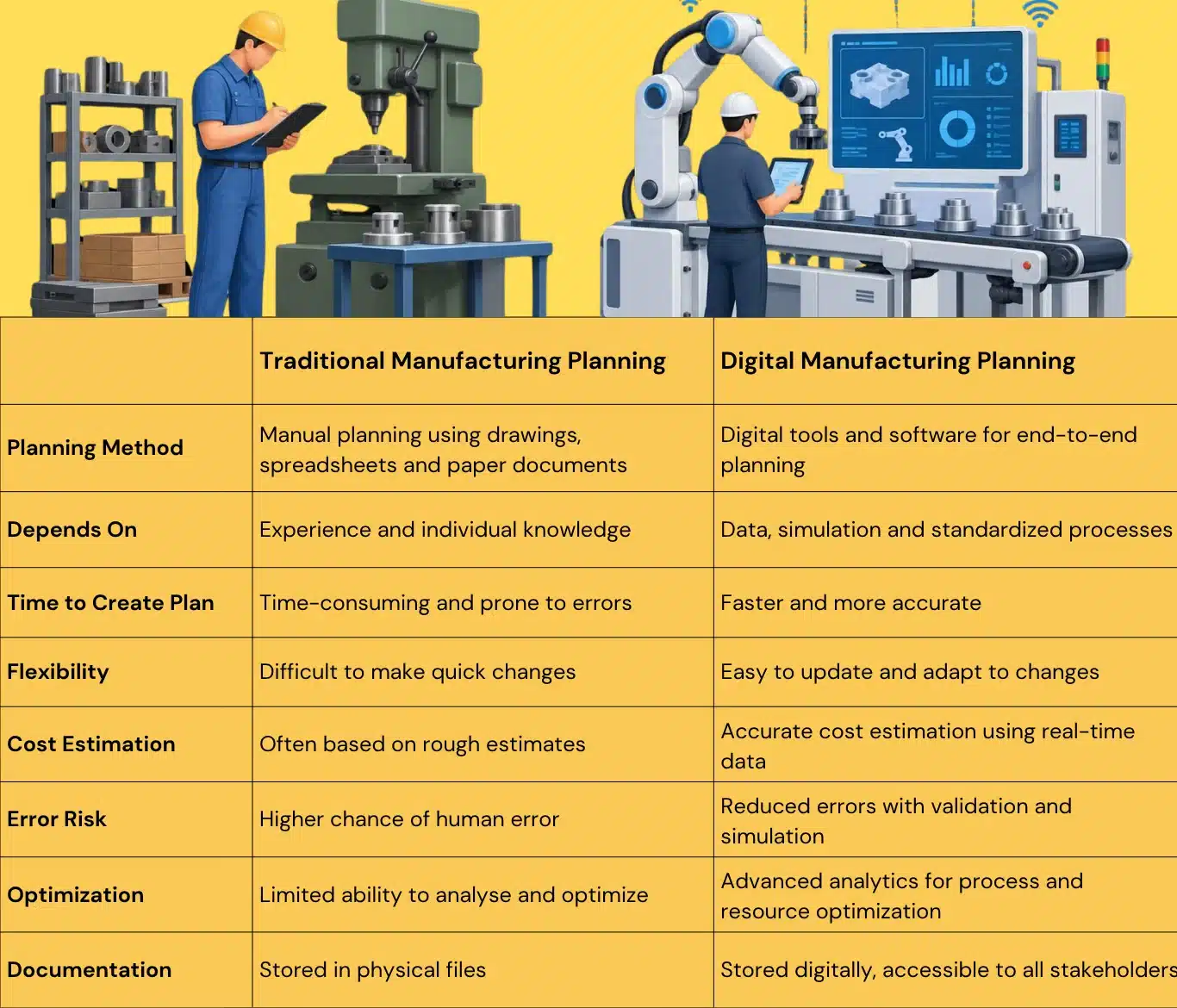
Traditional vs. Digital Manufacturing Planning
Understanding the shift from traditional to digital manufacturing planning is essential for modern production environments. The table below outlines the critical differences in planning methods, flexibility, accuracy, and overall efficiency.
Top Software Tools for Manufacturing Process Planning
Manufacturing process planning is closely connected with CAD and PLM tools used to design, simulate, and optimize production workflows. Engineers rely on these tools to move from concept design to real-world manufacturing with better accuracy and efficiency.
Tools like CATIA, Siemens NX, SOLIDWORKS, and PTC Creo are widely used across industries for 3D modeling, assembly design, simulation, and manufacturing integration.
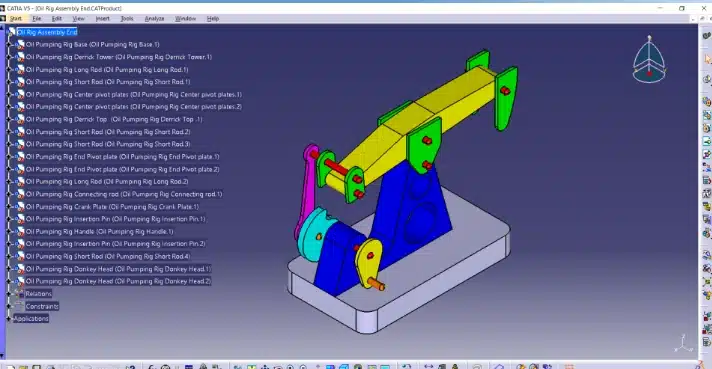
CATIA (V5 / V6)
CATIA is widely used in aerospace and automotive industries for complex product design and large assemblies.
In manufacturing planning, CATIA helps engineers:
- Design complex geometries and surface models
- Manage large assemblies with multiple components
- Prepare accurate design data for downstream manufacturing
- Integrate design with simulation and product lifecycle workflows
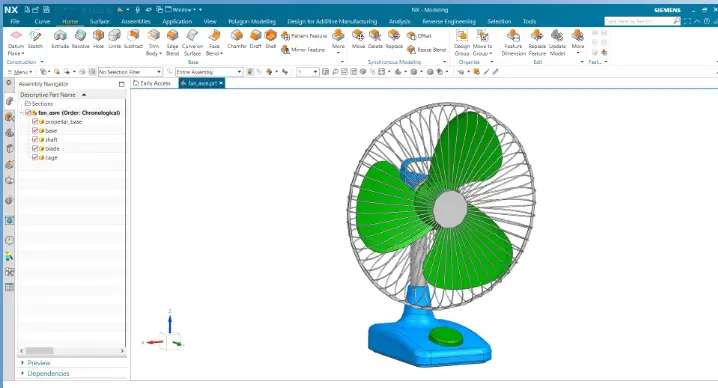
Siemens NX
Siemens NX is an integrated platform that combines CAD, CAM, and CAE in a single environment.
In manufacturing planning, NX is used to:
- Create 3D models and detailed engineering designs
- Plan machining operations using CAM modules
- Simulate manufacturing processes before production
- Optimize tool paths and reduce machining errors
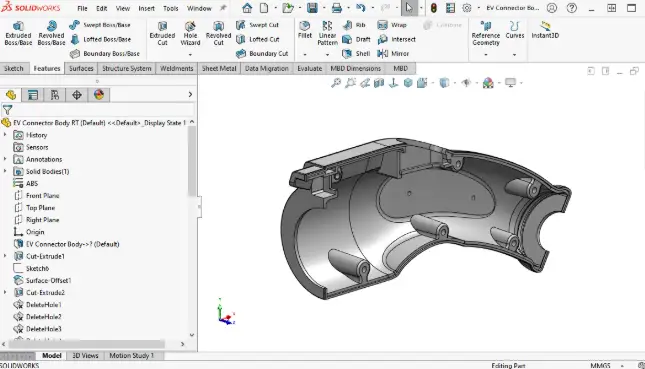
SOLIDWORKS
SOLIDWORKS is known for its ease of use and strong capabilities in mechanical design and assemblies.
In manufacturing planning, it helps:
- Develop part designs and assemblies quickly
- Validate designs using simulation tools
- Prepare production-ready drawings
- Support prototyping and product development workflows
PTC Creo
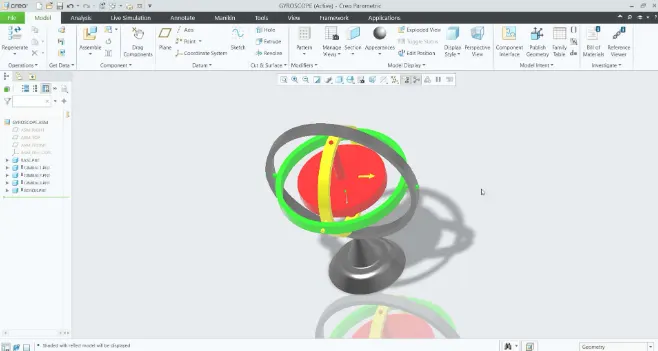
PTC Creo focuses on parametric design and product lifecycle management.
In manufacturing planning, Creo enables:
- Parametric modeling for design flexibility
- Design optimization and simulation
- Efficient handling of design changes
- Integration with PLM systems for better production coordination
Explore these industry-standard tools in more detail:
Role of PLM in Manufacturing Planning
While CAD tools help create and simulate product designs, manufacturing planning also depends on how effectively this data is managed, shared, and updated across teams. This is where Product Lifecycle Management (PLM) becomes essential.
Teamcenter (PLM System)
Teamcenter acts as the backbone that connects design, planning, and production by managing product data and workflows in a centralized system.
In manufacturing planning, it helps:
- Manage Bill of Materials (BOM) and product structures
- Connect CAD design data with manufacturing processes
- Track engineering changes and revisions
- Improve coordination between design and production teams
In real-world manufacturing environments, PLM ensures that everyone works with the latest and most accurate data, reducing errors and improving overall efficiency.
To see how PLM tools like Teamcenter are used in real manufacturing workflows, explore related learning modules and concepts:
Other Tools Used in Manufacturing Planning
In addition to CAD and PLM tools, manufacturing planning also involves enterprise-level software that supports production execution, resource management, and supply chain coordination.
Some commonly used solutions include:
- SAP S/4HANA Manufacturing
- Oracle Manufacturing Cloud
- Microsoft Dynamics 365 Supply Chain Management
- DELMIA (Dassault Systèmes)
- Autodesk Fusion Operations
- Epicor Kinetic
- Plex Manufacturing Platform
- Odoo Manufacturing
These tools help organizations manage production schedules, inventory, shop floor operations, and overall manufacturing efficiency at scale.
What Does Manufacturing Planning Software Do?
Manufacturing planning software helps organizations:
- Plan and schedule production efficiently
- Manage materials and inventory
- Allocate machines and workforce
- Track production performance in real time
- Ensure quality control at every stage
- Improve coordination between teams
Key Benefits
- Improved Visibility
Real-time data provides better control over production
- Reduced Lead Time
Faster planning and execution
- Better Resource Utilization
Machines and workforce are used efficiently
- Lower Costs
Reduced waste, rework, and delays
- Improved Decision-Making
Data-driven insights replace guesswork
For a deeper look at manufacturing design concepts, you can refer to: Top Manufacturing Design Courses By Tata Technologies
Common Challenges in Manufacturing Planning
Even with well-defined processes and modern tools, manufacturing planning comes with its own set of challenges. These issues can impact production efficiency, cost, and delivery performance.
- Demand Fluctuations
Sudden changes in customer demand make it difficult to plan production and maintain optimal inventory levels
- Supply Chain Disruptions
Delays in raw materials or components can interrupt production schedules
- Engineering Changes
Design modifications during production require updates in processes, tools, and routing
- Machine Downtime
Unexpected equipment failures can disrupt planned schedules and reduce productivity
- Workforce Availability
Shortage of skilled operators can limit production capacity
- Data Silos
Lack of integration between teams leads to poor communication and planning errors
- Inaccurate Planning Data
Incorrect estimates for time, cost, or capacity can affect the entire production flow
Addressing these challenges requires better planning strategies, use of digital tools, and continuous monitoring of production performance.
The Future of Manufacturing Process Planning
Manufacturing is entering a new era driven by intelligent technologies and connected ecosystems. Future manufacturing process planning will increasingly rely on real-time data, automation, and predictive analytics.
Several emerging trends are shaping the future:
- Artificial Intelligence (AI)
AI can analyse historical production data to recommend optimal schedules, predict bottlenecks, and improve resource allocation.
- Digital Twins
Digital twins create virtual representations of products, machines, or entire factories. Manufacturers can simulate production scenarios before implementing changes on the shop floor, reducing risk and improving decision-making.
- Industrial Internet of Things (IIoT)
Connected sensors continuously monitor equipment, enabling manufacturers to track machine health, production performance, and energy consumption in real time.
- Predictive Maintenance
Instead of repairing machines after a breakdown, predictive maintenance uses sensor data and analytics to identify potential failures before they occur, minimizing downtime.
- Sustainable Manufacturing
Manufacturers are increasingly incorporating sustainability into process planning by reducing waste, optimizing energy consumption, and selecting environmentally friendly materials and processes.
As these technologies mature, manufacturing planning will become more intelligent, agile, and data-driven, enabling organizations to respond quickly to changing market conditions.
Conclusion
Manufacturing process planning is the foundation of efficient and successful production. From defining processes and selecting resources to sequencing operations and ensuring quality, every decision made during planning directly impacts productivity, cost, and delivery performance.
A well-structured manufacturing plan helps organizations reduce errors, optimize resource utilization, and maintain consistent product quality. It also enables better coordination between design and production, ensuring that products are manufactured efficiently and on time.
As manufacturing continues to evolve with digital technologies, adopting smarter planning approaches and modern tools will become essential for staying competitive.
Whether you’re a student, engineer, or industry professional, understanding manufacturing process planning provides a strong advantage in managing and improving real-world production systems.
Explore the Manufacturing and Design Certificate Program by Tata Technologies
Advance your skills in manufacturing process planning with the Manufacturing and Design Certificate Program by Tata Technologies, designed for practical, industry-ready learning.
Explore ProgramContact UsFAQs
Manufacturing process planning defines how a product will be manufactured, including processes, machines, tools, and operation sequence.
It improves efficiency, reduces costs, ensures product quality, and enables on-time delivery.
Manufacturing process planning focuses on how to make a product, while production planning focuses on when and how much to produce.
The main steps include understanding requirements, reviewing design, selecting processes, planning resources, defining routing, and setting quality checkpoints.
A routing sheet outlines the sequence of operations and machines required to manufacture a product.
DFM is a design approach that simplifies manufacturing, reduces cost, and improves production efficiency.
Material type, product design, production volume, required accuracy, surface finish, and cost constraints.
Manufacturing planning software helps plan, schedule, and optimize production using real-time data and integrated systems.
Challenges include demand fluctuations, supply chain disruptions, machine downtime, and lack of integrated data.
The future involves AI, digital twins, IIoT, and data-driven systems for smarter and more efficient production planning.

Prateek Potnis
Related Posts

How to Insert a Sketch Picture in SOLIDWORKS (Step-by-Step Guide)

CATIA V5 Tutorial – How to Use Note Object Attribute with Ditto
Geneva Mechanism Explained: Working Principle, Design & Applications

What is Fluid Mechanics? – Introduction, Laws & Equations

What Is AutoCAD Software? Uses, Features & Practical Examples
Find
Categories
Latest Posts

Manufacturing Process Planning: Step-by-Step Guide for Engineers
September 10, 2026

Popular Tags