

Corporate Training for Design Engineers: Improving Design Efficiency & Reducing Rework
August 18, 2026 2026-08-27 18:11Corporate Training for Design Engineers: Improving Design Efficiency & Reducing Rework
Corporate Training for Design Engineers: Improving Design Efficiency & Reducing Rework
Engineering organizations today are under increasing pressure to deliver faster product development while maintaining high design quality. However, despite significant investments in advanced CAD tools and digital engineering technologies, many companies continue to face delays, repeated design rework, and underutilized software capabilities—challenges that highlight the growing importance of corporate training for design engineers in improving efficiency and overall business performance.
At the heart of this issue is a widening skills gap. Engineering teams often struggle to keep pace with rapidly evolving technologies, industry standards, and customer expectations, turning what was once a training concern into a measurable business risk.
This is where corporate training for design engineers moves beyond a learning initiative and becomes a strategic investment. Organizations that consistently upskill their teams can improve engineering performance, support technology adoption, reduce inefficiencies, and strengthen workforce capability. The World Economic Forum reports that 39% of workers’ core skills are expected to change by 2030, while 63% of employers identify skills gaps as a major barrier to business transformation.
In this blog, we explore why Design Engineer Training Programs, Design Engineer Courses, and customized Design Engineer Corporate Training solutions are becoming increasingly important for engineering-driven organizations—and how they can contribute to improvements in productivity, quality, and development speed.
Table of Contents
The Growing Skills Gap in Engineering
Engineering is changing quickly, and the skills required to keep up are changing with it. Technologies such as artificial intelligence, digital twins, model-based design, Industry 4.0, cloud engineering, generative design, and simulation-driven development are changing how products are designed, tested, and manufactured.
For engineering organizations, adopting these technologies is only one part of the challenge. The bigger question is whether their teams have the skills to use them effectively. Engineers may be experienced in existing tools and processes, but new software capabilities, evolving engineering standards, and changing workflows can quickly create gaps in technical knowledge.
The World Economic Forum’s Future of Jobs Report 2025 identifies skills gaps as a major barrier to business transformation and highlights AI, big data, and technological literacy among the fastest-growing skill areas.
When teams are not adequately prepared to adopt new technologies or engineering processes, organizations may experience:
- Lower engineering productivity
- Increased design rework and inconsistencies
- Longer product development cycles
- Underutilization of engineering software
- Slower technology adoption
- Inconsistent skills across teams
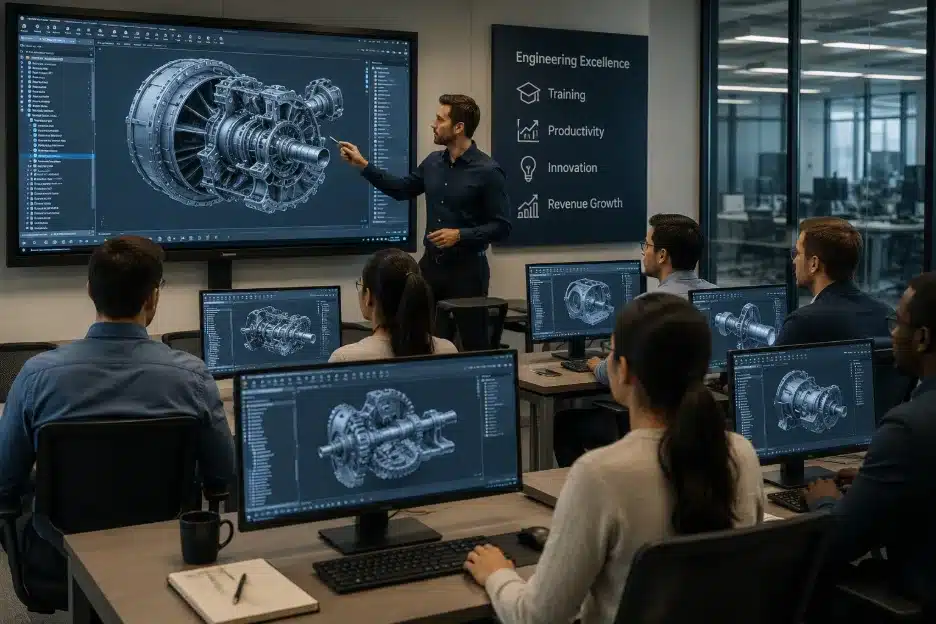
This is why design engineer training programs are becoming an important part of workforce development. Rather than treating training as a one-time activity, organizations can use continuous engineering workforce training to build technical capabilities, support technology adoption, and keep engineering teams aligned with changing business requirements.
For companies investing in new engineering tools and technologies, closing the skills gap is ultimately about getting greater value from both their people and their technology investments.
Why Corporate Training Matters for Design Engineers
Design engineers are at the heart of product innovation. Whether creating aircraft structures, automotive components, industrial machinery, or consumer products, their knowledge directly influences:
- Product quality
- Manufacturing efficiency
- Development cost
- Compliance
- Customer satisfaction
However, engineering knowledge can quickly become outdated. As technologies and engineering workflows evolve, organizations need to continuously develop the skills of their design teams.
A designer trained on software several years ago may not be utilizing newer capabilities such as:
- Parametric modeling automation
- Knowledge-based engineering
- Generative design
- Simulation integration
- Digital thread workflows
- Collaborative cloud environments
Corporate training for design engineers helps bridge this knowledge gap by keeping technical skills aligned with evolving technologies, engineering standards, and business requirements.
Top Corporate Training Courses for Design Engineers
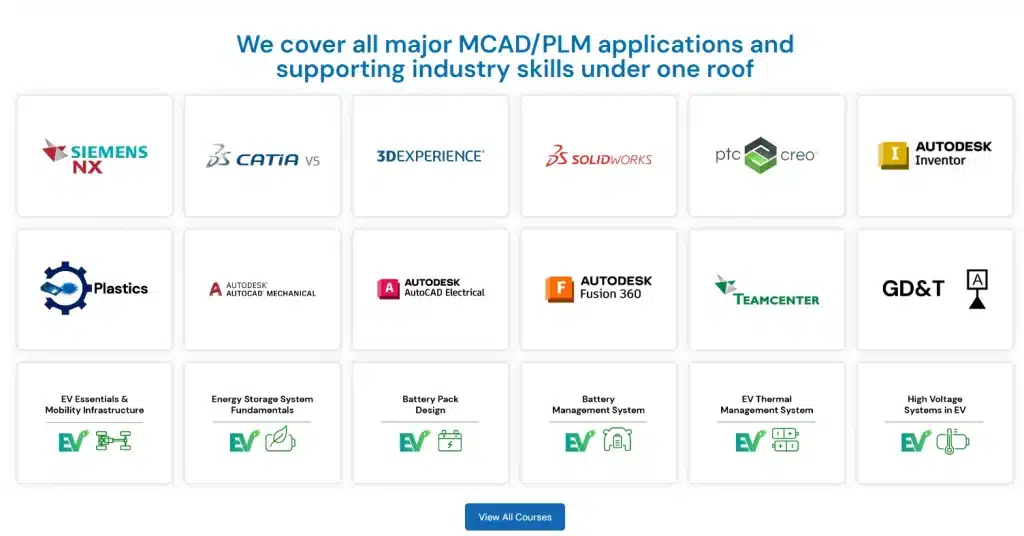
At i GET IT by Tata Technologies, corporate training is not limited to individual tools—it is designed as a complete, scalable learning ecosystem for engineering teams. With structured learning paths, hands-on modules, and enterprise-ready LMS capabilities, organizations can upskill teams across MCAD, EV, PLM, GD&T, and domain-specific engineering skills.
Below are the key corporate training programs that help design engineers improve productivity, reduce errors, and accelerate product development.
1. Corporate CAD Design Training for Design Engineers
Our MCAD training programs are built to help engineers master end-to-end product design workflows, from fundamentals to advanced modeling and simulation.
With access to one of the largest engineering learning catalogs, teams can learn across multiple CAD platforms in a standardized and scalable way.
What engineers learn:
- 3D modeling, assemblies, and drafting
- Advanced surfacing and freeform design
- Large assembly management and parametric design
- Sheet metal, routing, and manufacturing basics
- CAD-integrated simulation and motion analysis
Key Tools covered:
- Siemens NX (with 1000+ hours across essentials, advanced modeling, simulation, and CAM)
- CATIA V5 & 3DEXPERIENCE (V6)
- PTC Creo & Windchill integration
- SOLIDWORKS
- Autodesk Inventor, AutoCAD Mechanical & Fusion 360
Enterprise advantage:
- Structured learning paths for different roles
- Continuous updates with latest CAD versions
- Hands-on project-based learning
- Certifications for each module
This ensures engineers not only learn tools but apply them effectively in real-world product development environments.
2. Corporate EV Training for Design Engineers
With the rapid growth of electric mobility, i GET IT offers specialized EV training programs that help engineers transition into next-gen technologies.
These programs are designed to build deep technical understanding of EV systems, not just surface-level concepts.
What engineers learn:
- Fundamentals of electric vehicles and mobility systems
- Battery technologies and energy storage systems
- Battery pack design and architecture
- Battery Management Systems (BMS)
- Thermal management and cooling strategies
- High voltage systems and safety
Key training programs include:
- EV Essentials (Basics & Fundamentals)
- Energy Storage System Fundamentals
- Battery Pack Design
- Battery Management System (BMS)
- Thermal Management Systems in EV
- High Voltage Systems in EV
- EV CAD Design with Siemens NX
Enterprise advantage:
- Future-ready workforce aligned with EV industry demand
- Integration of CAD + EV workflows
- Certification-based structured programs
- Flexible, scalable training for teams
This enables organizations to build EV-ready engineering teams capable of designing next-generation products.
3. Corporate PLM Training for Design Engineers
Product Lifecycle Management (PLM) is critical for managing complex product data, workflows, and collaboration across teams.
i GET IT’s PLM training focuses on helping engineers and organizations streamline product development processes and improve efficiency.
What engineers learn:
- Product data management and version control
- Change management workflows
- Digital product lifecycle processes
- CAD-PLM integration
- Collaboration across distributed teams
Key Tools covered:
- Siemens Teamcenter (Rich Client, Change Manager, Structure Manager, Visualization)
- NX + Teamcenter integration
- PTC Windchill with Creo
Enterprise advantage:
- Improved cross-team collaboration
- Standardized engineering workflows
- Faster design iterations and approvals
- Better control over product data
This ensures organizations can scale engineering operations while maintaining consistency and traceability.
4. Corporate GD&T and ISO GPS Training for Design Engineers
Precision and standardization are critical in engineering—and that’s where GD&T and ISO GPS training plays a major role. i GET IT provides in-depth, standards-aligned training to help engineers communicate design intent clearly and accurately.
What engineers learn:
- GD&T fundamentals and advanced applications
- ASME Y14.5 standards (1994, 2009, 2018)
- Datum structures, tolerances, and symbols
- Inspection and quality control concepts
- ISO GPS standards for global compliance
Training highlights:
- 50+ hours of GD&T training
- 300+ assessment questions
- Real-world applications and case studies
- Module-wise certifications
Enterprise advantage:
- Reduced manufacturing errors and rework
- Improved design clarity and communication
- Better alignment between design and production teams
This helps teams bridge the gap between design, manufacturing, and quality assurance.
5. Corporate Plastics & Injection Mold Training for Design Engineers
For industries like automotive and manufacturing, plastics design is a critical skill. i GET IT’s plastics training focuses on practical, production-ready knowledge required for real-world applications.
What engineers learn:
- Injection molding fundamentals
- Plastic material behavior and selection
- Mold design concepts
- Shrinkage, gating, and flow analysis
- Design for manufacturability in plastics
Enterprise advantage:
- Improved product quality and manufacturability
- Reduced design iterations
- Faster time-to-market
This ensures engineers can design components that are optimized for both performance and manufacturing efficiency.
Why These Corporate Training Programs Matter
Together, these programs create a complete engineering learning ecosystem that helps organizations:
- Build high-performance engineering teams
- Reduce design errors and rework
- Accelerate product development cycles
- Standardize skills across teams
- Adapt to evolving technologies like EV and digital manufacturing
With customizable learning paths, LMS-driven insights, and scalable training delivery, i GET IT enables companies to move beyond fragmented training and build a future-ready workforce.
The Business ROI of Design Engineer Corporate Training
For engineering organizations, training should deliver more than improved technical knowledge. The real value lies in how stronger skills translate into higher productivity, faster development cycles, and more effective use of engineering investments.
- Reduce Design Errors and Rework
Well-trained design engineers are better equipped to follow design standards and use efficient workflows. This helps reduce design revisions, inconsistencies, and downstream manufacturing issues.
- Accelerate Product Development
Strong knowledge of advanced CAD capabilities enables engineers to automate repetitive tasks, reuse design knowledge, and work more efficiently—supporting shorter product development cycles.
- Maximize Software Investments
Organizations invest heavily in platforms such as CATIA, Siemens NX, Creo, SolidWorks, and AutoCAD. Training ensures teams fully utilize these tools instead of relying only on basic functionalities, improving overall engineering efficiency.
- Strengthen Employee Retention
Continuous learning supports long-term workforce development. Providing engineers with opportunities to build relevant technical skills improves engagement, supports career growth, and strengthens retention.
For B2B decision-makers, the ROI of corporate training for design engineers should be measured by its impact on productivity, quality, development speed, technology adoption, and overall engineering capability—not simply by the number of employees who complete a course.
Real-World Impact of Engineering Training
Several engineering organizations have achieved measurable business outcomes through structured workforce training:
- Siemens India used targeted engineering upskilling to reduce graduate onboarding costs by 40%, while shortening training time from five months to three and improving new-hire readiness.
- GE Aerospace adopted immersive AR/VR-based technical training, reducing training time by 20–40% and enabling faster deployment of engineering talent.
- Toyota streamlined its engineering training environments, reducing setup time from a full day to about two hours and significantly accelerating training readiness for large teams.
These examples show that corporate training for design engineers is not just a learning initiative—it directly improves onboarding efficiency, training speed, and overall engineering productivity.
How Can Companies Measure the ROI of Engineering Training?
Organizations can track training effectiveness through practical business and learning metrics such as:
- Time-to-proficiency for new tools or workflows
- Training completion and assessment results
- Adoption of new software features
- Design rework and revision rates
- Product development cycle time
- First-time-right performance
- Employee skill progression
- Application of training to project work
The right metrics will vary by organization, but the goal is the same: connect learning activity to measurable engineering and business outcomes.
An Illustrative Engineering Scenario
Imagine an aerospace supplier implementing a new CATIA V5 design environment.
The company invests in:
- Software licenses
- Engineering hardware
- Process documentation
However, engineers continue relying on familiar design methods instead of using the new environment effectively.
The result?
- Slow technology adoption
- Inconsistent modeling practices
- Collaboration challenges
- Longer review cycles
- Potential project delays
Now, consider the organization introducing a customized Design Engineer Corporate Training program aligned with its workflows and technology.
.
The training can help engineers:
- Apply standardized modeling practices
- Develop advanced design skills
- Use more of the software’s capabilities
- Collaborate more effectively
- Adapt faster to new engineering workflows
The key takeaway is simple: investing in engineering technology is only part of the equation. Organizations also need to invest in the skills required to use that technology effectively.
Untrained vs. Trained Engineering Teams
The difference between having engineering tools and having teams that can use them effectively can have a direct impact on project outcomes.
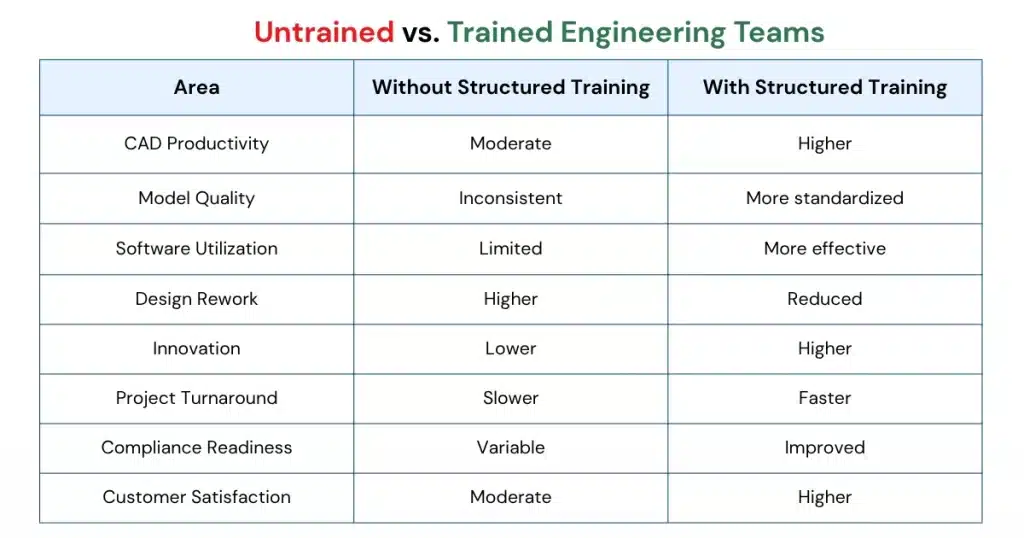
The key takeaway is that corporate training for design engineers is not simply about improving individual skills. It can help create more consistent processes, better use of engineering software, and more predictable project outcomes.
Emerging Technologies Reshaping Design Engineering
The skills required from design engineers are evolving as new technologies become part of modern engineering workflows. Companies are no longer training teams only on traditional CAD tools; they also need capabilities that support connected, data-driven, and increasingly automated product development.
- Artificial Intelligence in Design
AI is helping design engineers automate repetitive tasks, explore design alternatives, and optimize designs more efficiently. As AI becomes increasingly integrated into engineering workflows, organizations need to build AI literacy alongside traditional technical skills.
- Digital Twins & Generative Design
Digital twins provide virtual representations of products that support design, testing, and optimization, while generative design enables engineers to explore multiple optimized design solutions based on defined requirements and constraints.
- Cloud-Based Collaboration
Cloud-based engineering platforms enable real-time collaboration, version control, information sharing, and faster design reviews across distributed teams, making connected design workflows increasingly important.
- Smart Manufacturing Integration
Modern engineering connects design, manufacturing, quality, and supply chain more closely than before. Engineers therefore need broader digital and cross-functional capabilities to understand how design decisions influence downstream processes.
As engineering technology evolves, organizations need to continuously update their workforce capabilities—not just purchase new tools. Corporate training for design engineers helps teams build the skills needed to adopt emerging technologies and apply them effectively.
Strong understanding of design standards like GD&T is essential for reducing errors and improving product quality. Learn more in What is GD&T and Why is it Important for Design Engineers?
Choosing the Right Engineering Training Solution
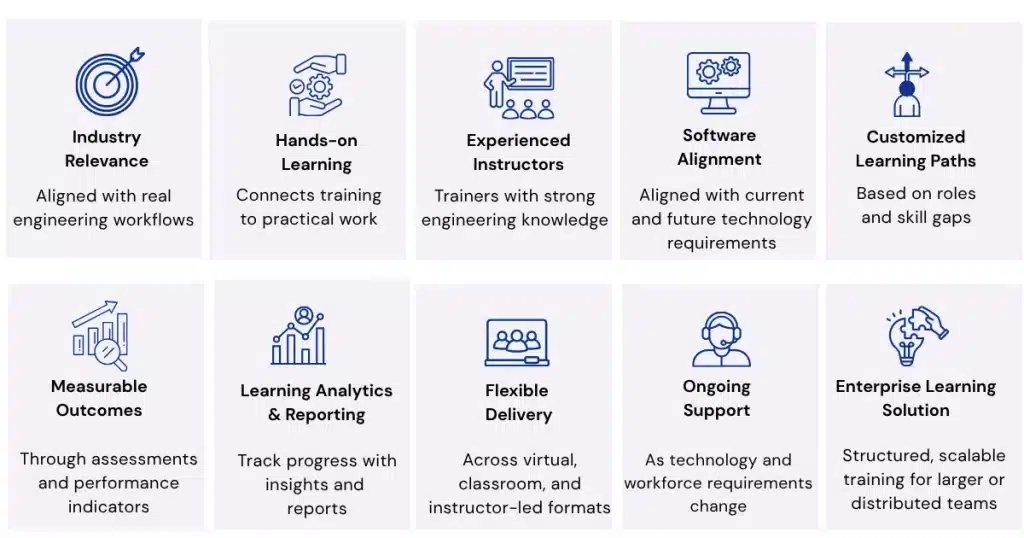
For larger or distributed engineering teams, these capabilities can bring training together into a more structured enterprise learning solution rather than relying on disconnected courses or one-time workshops.
How to Choose the Right Design Engineer Courses
Not all training programs deliver the same value. For engineering organizations, the right Design Engineer Courses should address actual skill requirements while supporting measurable improvements in engineering performance.
When evaluating a training program, organizations should consider:
Industry Relevance
Training should align with the organization’s engineering workflows, technologies, and industry requirements.
Hands-On Learning
Practical exercises and project-based learning help engineers apply new skills to real engineering situations.
Expert Instructors
Industry-experienced trainers can connect technical concepts with real-world engineering practices.
Software Alignment
Programs should support the engineering software and technology ecosystems teams currently use—or plan to adopt.
Measurable Outcomes
- Training effectiveness can be evaluated through:
- Assessments
- Project performance
- Skill progression
- Productivity improvement
- Certification achievement
The key is to choose training that connects learning with real engineering work—not simply a program with a large number of courses.
From Skills Gaps to Scalable Engineering Learning
As engineering teams grow, training needs become more complex. Organizations may need to close skill gaps, onboard new engineers, support multiple engineering platforms, and track learning across teams.
An enterprise learning solution brings these needs together through role-based learning paths, customized technical training, centralized learning, and learner insights.
Depending on business requirements, this can support areas such as MCAD, PLM, EV technologies, GD&T, CAD, and digital manufacturing, while enabling organizations to build a more scalable and measurable approach to engineering workforce development.
| Challenge | Learning Solution | Business Outcome |
|---|---|---|
|
Skills gaps |
Role-based learning |
Stronger capabilities |
|
New employee onboarding |
Structured training |
Faster readiness |
|
CAD-system changes |
Targeted training |
Smoother adoption |
|
Different skill levels |
Standardized learning |
Consistent practices |
|
Tracking learning |
LMS + learner insights |
Measurable progress |
|
Custom requirements |
Customized content |
Workflow-aligned training |
|
Distributed teams |
Workflow-aligned training |
Consistent development |
The Future of Engineering Workforce Development
Engineering workforce development is shifting from one-time training to continuous learning. As technologies, engineering tools, and workflows evolve, organizations must keep their teams’ skills aligned with changing requirements.
Future-ready design engineers will need a combination of:
- Strong engineering fundamentals
- Digital engineering and software expertise
- AI and technology literacy
- Systems thinking
- Cross-functional collaboration
The World Economic Forum estimates that 59 out of every 100 workers will need training by 2030 (including upskilling and reskilling), highlighting the growing importance of continuous workforce development. For engineering organizations, the goal is no longer to train employees only when new technologies emerge, but to build a continuous learning culture that keeps design engineers’ capabilities aligned with evolving tools, workflows, and industry demands.
(Source: World Economic Forum, Future of Jobs Report 2025)
Conclusion
Engineering excellence depends not only on the technology organizations invest in, but also on the capabilities of the people using it. As CAD tools, engineering processes, and industry requirements continue to evolve, keeping design teams’ skills up to date is becoming a strategic priority.
Corporate training for design engineers can help organizations close skills gaps, improve technology adoption, strengthen engineering capabilities, and support more efficient product development. The most effective approach connects learning with real engineering workflows, business requirements, and measurable outcomes.
For engineering-driven organizations, continuous workforce development is no longer just about keeping employees trained. It is about building future-ready teams that can adapt, innovate, and get greater value from their technology investments.
Enterprise Design Engineer Training
Upskill your teams with structured learning across CAD, PLM, EV technologies, and industry-specific engineering skills.FAQs
Corporate training for design engineers is a structured learning approach that helps engineering teams improve skills in CAD tools, product development workflows, and emerging technologies to enhance productivity, design quality, and business performance.
Corporate training is important because it helps design engineers stay updated with evolving technologies, reduce design errors, improve efficiency, and accelerate product development in competitive engineering environments.
Corporate training improves productivity by enabling engineers to use advanced CAD features, automate repetitive tasks, follow standardized workflows, and reduce rework during product development.
Modern design engineers need skills in digital engineering tools, CAD/PLM systems, AI-assisted design, systems thinking, and cross-functional collaboration to meet evolving industry demands.
Corporate training helps organizations reduce design errors, accelerate development cycles, improve software utilization, enhance workforce capability, and achieve better ROI on engineering investments.
ROI can be measured through improvements in productivity, reduction in design rework, faster project timelines, better software adoption, and increased employee retention.
Without training, organizations often face skills gaps, inefficient use of CAD tools, inconsistent design practices, delayed projects, and higher operational costs.
Organizations should look for industry-relevant content, hands-on learning, software alignment, customized learning paths, measurable outcomes, and scalable delivery for distributed teams.
Technologies like AI, digital twins, and cloud collaboration require continuous upskilling, making training essential for engineers to adapt to modern, data-driven design environments.
Organizations can build a learning culture by implementing structured training programs, role-based learning paths, performance tracking, and ongoing skill development aligned with business goals.
The best approach is to implement continuous, role-based training programs that combine hands-on learning, software expertise, and measurable outcomes to improve engineering performance, productivity, and innovation.

Vinay
Related Posts

Aircraft Tail Designs and Configurations: Types of Empennage Explained

Top Manufacturing Design Courses By Tata Technologies

Best Product Design Courses by Tata Technologies
SOLIDWORKS Certification: Top Courses, Prep Tips & Salaries
Top Automotive Design Engineer Courses by Tata Technologies
Find
Categories
Latest Posts

Battery Management System (BMS) in EVs: Working & Functions
October 6, 2026
Sketch Checking in Siemens Designcenter: A Quick Tech Tip
September 30, 2026
Manufacturing Process Planning: Step-by-Step Guide for Engineers
September 10, 2026Popular Tags