

Battery Management System (BMS) in EVs: Working & Functions
October 6, 2026 2026-10-06 17:23Battery Management System (BMS) in EVs: Working & Functions
Battery Management System (BMS) in EVs: Working & Functions
Electric vehicles might look simple from the outside—no engine noise, no fuel tank, just a battery powering everything. But what most people don’t see is the complex system working behind the scenes to make sure that battery operates safely and efficiently. This system is known as the Battery Management System (BMS) in EVs, and it plays a critical role in how electric vehicles function.
If you’re new to electric vehicles—or have heard about them but never explored how they actually work—understanding the Battery Management System can help you see what truly powers EV performance.
In modern electric vehicles, the Battery Management System (BMS) acts as the intelligence behind the battery. It continuously monitors factors like charge level, temperature, and overall battery health, while also making real-time decisions to prevent damage, improve performance, and extend battery life.
As EV technology continues to evolve, understanding the Battery Management System in EVs is becoming increasingly important—not just for engineers, but for anyone curious about how electric vehicles actually work or looking to build a career in this rapidly growing industry.
Table of Contents
What is a Battery Management System (BMS)?
A Battery Management System (BMS) is the control system of an EV battery that tracks its performance, prevents damage, and optimizes battery life by managing charging, temperature, and cell balance.
What Is a Battery Management System (BMS) in an EV?
A Battery Management System (BMS) in electric vehicles is an electronic control system that monitors and manages the battery’s performance. It tracks parameters like voltage, current, temperature, and charge level to ensure the battery operates safely, efficiently, and lasts longer.
Why Battery Management System (BMS) Matters in an EV
At a basic level, the Battery Management System (BMS) in EVs monitors and controls the battery—but its real importance becomes clear when you look at what could happen without it.
An EV battery is made up of multiple individual cells working together as a pack. It’s a complex system made up of many cells operating under high voltage and varying conditions. Without intelligent control, even small imbalances or temperature changes could lead to performance issues, faster degradation, or safety risks.
The BMS ensures that the battery doesn’t just work—but works reliably, safely, and efficiently in real-world conditions.
1. Ensuring Safety at All Times
Safety is the most critical reason why a BMS exists. EV batteries store a large amount of energy, and operating outside safe limits can be dangerous.
The BMS continuously monitors for abnormal conditions and steps in when required.
For example, it protects against:
- Overcharging and deep discharge
- Excessive current flow
- Overheating or sudden temperature rise
If something goes wrong, the system can immediately reduce power, stop charging, or even disconnect the battery to prevent damage.
In simple terms, the BMS acts as a real-time safety guardian for the entire battery system.
2. Extending Battery Life
Battery replacement is one of the most expensive parts of an EV, so maintaining battery health is extremely important.
The BMS helps extend battery life by ensuring that the cells operate within safe limits. It avoids conditions that accelerate degradation, such as high temperature, overcharging, or deep discharge.
This is achieved by:
- Keeping voltage and current within safe ranges
- Managing temperature effectively
- Preventing uneven stress across cells
By controlling these factors, the BMS ensures the battery remains usable for a longer period.
3. Maintaining Range and Performance
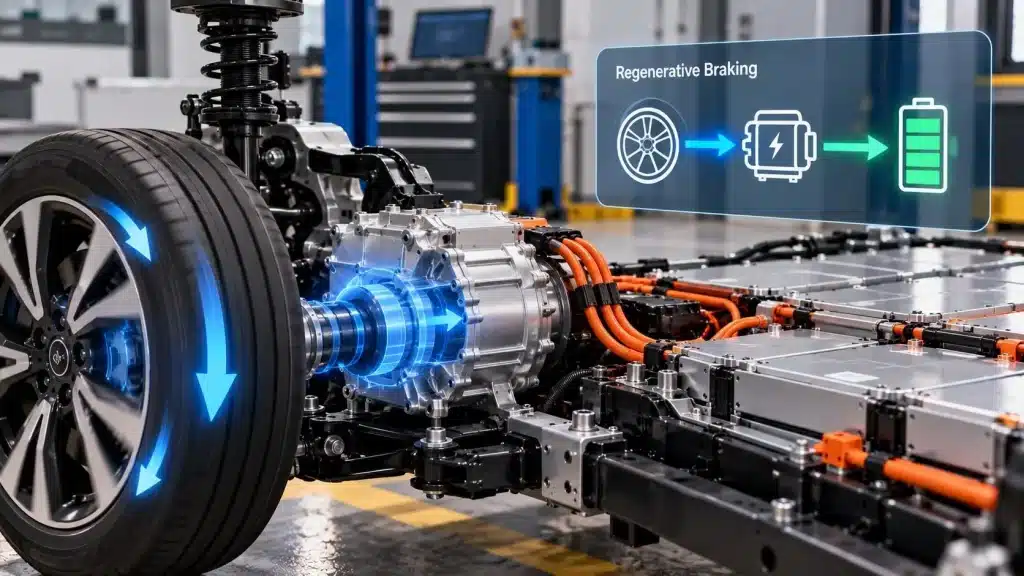
An EV’s range and performance are not just dependent on battery size—they are heavily influenced by how efficiently that battery is managed . The BMS optimizes how energy is used and delivered, ensuring consistent performance across different driving conditions.
It considers factors like:
- Battery condition and age
- Temperature
- Charge level
- Cell imbalance
This is why the same EV may perform differently in different conditions—the BMS is constantly adjusting to maintain balance.
4. Controlling Charging Behavior
Charging an EV is not simply about supplying power—the process needs to be carefully controlled to protect the battery.
The BMS decides:
- How fast the battery should charge
- When to slow down charging
- How to handle different temperature condition
That’s why charging is usually fast at the beginning but slows down as the battery gets closer to full capacity.
This controlled behavior helps:
- Prevent overheating
- Reduce stress on the battery
- Improve long-term durability
How Does a BMS Work in an Electric Vehicle?

The Battery Management System (BMS) in an electric vehicle operates through a continuous cycle of monitoring, analysis, and control.
It begins by collecting real-time data from the battery, including voltage, current, and temperature. This information provides a real-time picture of the battery’s current condition.
Based on this input, the system processes the information to estimate key parameters like State of Charge (SoC) and State of Health (SoH), while also identifying any abnormal or unsafe conditions.
Once the analysis is complete, the BMS takes action—regulating charging and discharging, limiting power when required, and activating cooling or safety systems to protect the battery.
This continuous loop ensures that the battery operates safely, efficiently, and reliably under different conditions.
Key Functions of Battery Management System (BMS)
The Battery Management System (BMS) in EVs is responsible for managing multiple complex operations inside the battery pack. These functions ensure that the battery performs efficiently, remains safe, and lasts as long as possible. Each function plays a critical role in real-world EV performance.
1. Monitoring Battery Conditions
Everything starts with understanding what’s happening inside the battery. The BMS continuously observes the internal condition of the battery pack by collecting real-time data. This allows it to detect even small irregularities before they turn into serious issues.
To do this, it keeps track of:
- Voltage across individual cells
- Current flowing during charging and driving
- Temperature at different points in the battery
This constant monitoring forms the foundation of all decisions, because without accurate data, the system cannot respond correctly.
2. Estimating Battery State (SoC & SoH)
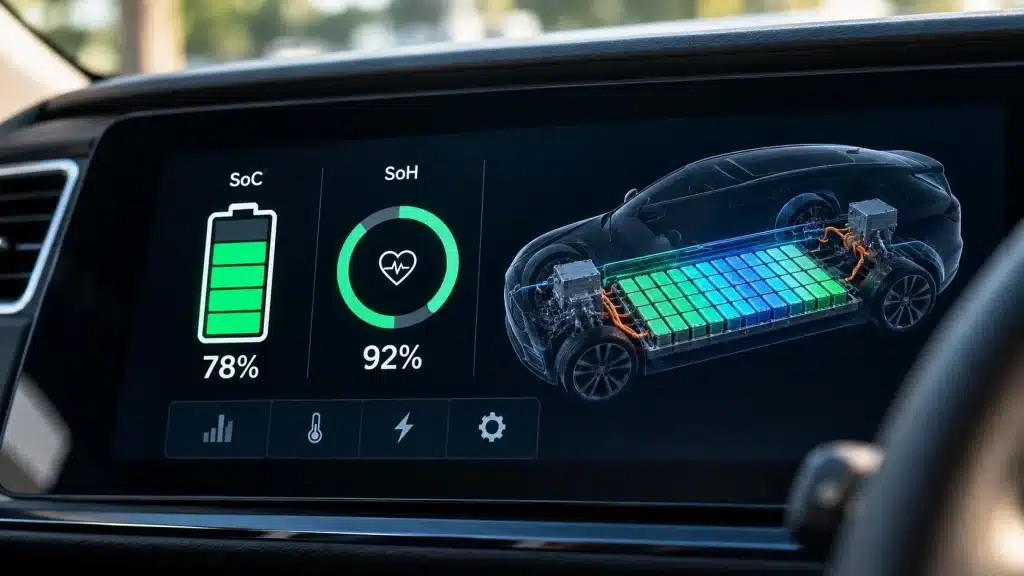
Once the data is collected, the BMS interprets it to understand the actual condition of the battery. Unlike fuel in a traditional vehicle, battery energy cannot be directly measured. Instead, the system calculates values like State of Charge (SoC) and State of Health (SoH).
SoC tells how much energy is available, while SoH indicates how much the battery has aged over time. These values are influenced by multiple factors such as temperature, driving patterns, and charging behavior.
This is why battery percentage or range may sometimes feel inconsistent—it’s not a fixed reading, but a smart estimation based on real-time conditions.
3. Protecting the Battery from Damage
One of the most important responsibilities of the BMS is ensuring safety. EV batteries operate under high voltage and store a large amount of energy, so even small issues can become serious if not handled properly.
The system continuously checks for unsafe conditions like:
- Overcharging or deep discharge
- Excessive current flow
- Sudden rise in temperature
If anything goes beyond safe limits, the BMS immediately takes action—such as reducing power, slowing down charging, or temporarily restricting battery usage. These actions may slightly affect performance, but they are essential to prevent long-term damage.
4. Managing Battery Temperature
Battery performance is highly sensitive to temperature, which makes thermal management a critical function. If the battery gets too hot, it can degrade faster; if it gets too cold, efficiency drops and charging slows down.
The BMS constantly monitors temperature and works with the vehicle’s cooling or heating systems to maintain the right balance. For example, during fast charging, it may reduce charging speed or activate cooling to avoid overheating.
This ensures the battery operates within a safe and efficient temperature range at all times.
5. Maintaining Cell Balance
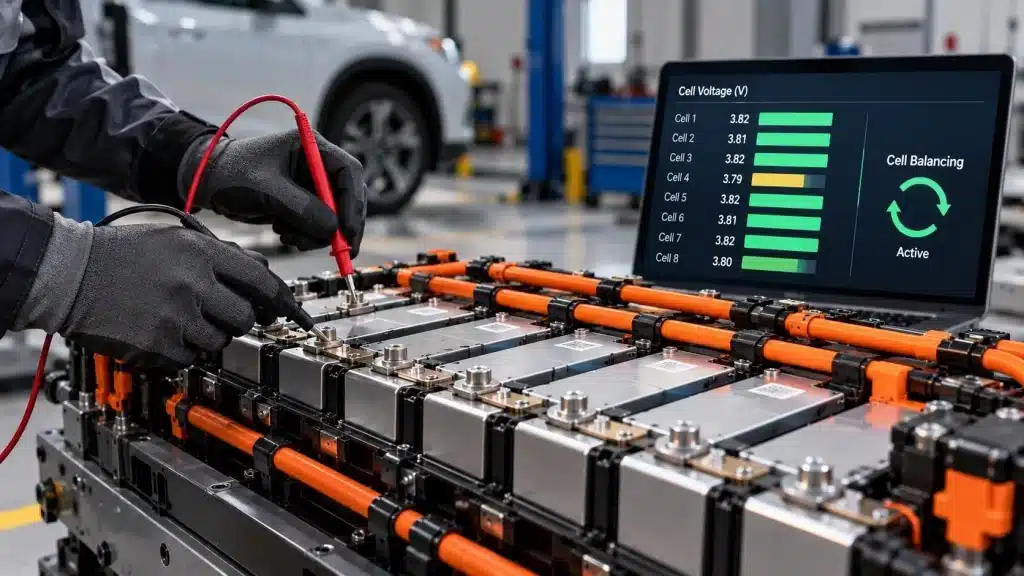
An EV battery is made up of hundreds or even thousands of cells, and over time, these cells do not behave exactly the same. Some may charge faster, while others may degrade quicker.
If this imbalance is not managed, it can reduce overall battery capacity and affect performance. The BMS solves this by continuously adjusting and balancing the cells so they operate uniformly.
This helps in maintaining:
- Consistent performance
- Better usable energy
- Longer battery lifespan
6. Controlling Charging and Power Delivery
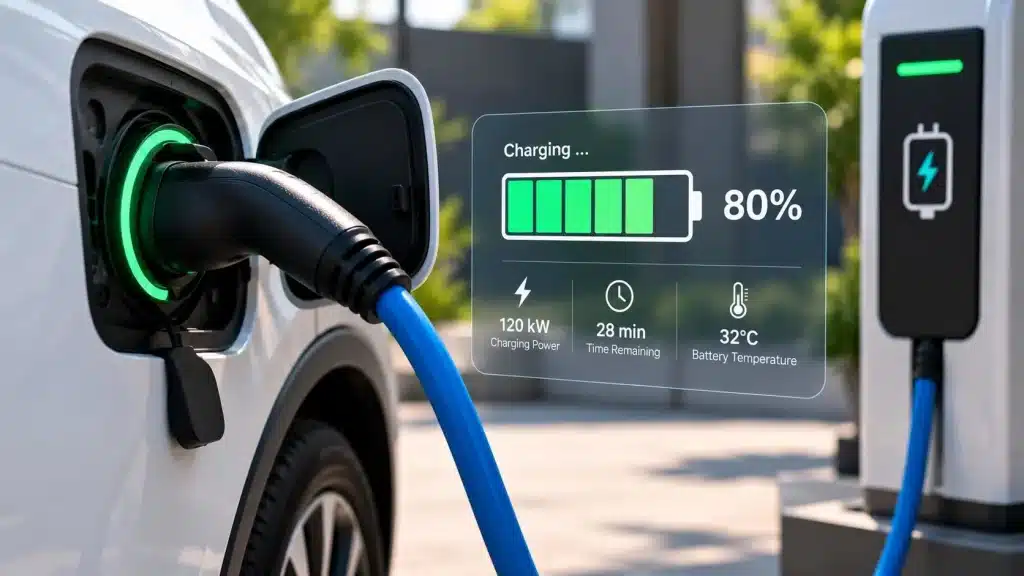
Charging an EV battery is a carefully controlled process. The BMS sets safe charging limits and coordinates charging with the charger, while also determining how much power the battery can safely deliver during driving.
These decisions depend on several factors like battery level, temperature, and overall condition. That’s why charging is fast at the beginning but slows down as it approaches full capacity—the system is reducing stress on the battery.
By controlling power flow intelligently, the BMS ensures both performance and long-term durability.
7. Communicating with Vehicle Systems
The BMS does not work alone—it continuously interacts with other systems inside the vehicle. It shares important information with components like the motor controller, charging system, and dashboard.
This includes data such as:
- Battery level and health
- Available power
- Temperature conditions
- Fault alerts
This communication ensures that all systems work together smoothly, allowing the vehicle to respond correctly in different situations.
Common EV Battery Types: LFP vs NMC Explained Simply
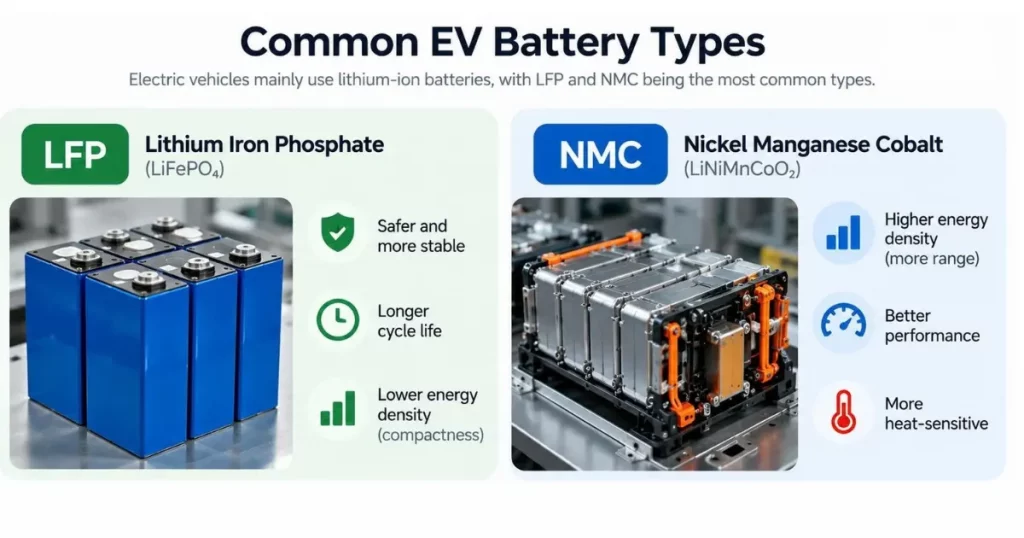
Concept Explanation: EV Battery Types (LFP vs NMC)
Electric vehicles mainly use lithium-ion batteries, but the two most common types—LFP and NMC—are built differently and behave differently in real-world conditions. The core difference comes down to how each balances safety, lifespan, and energy density.
LFP batteries are designed for stability and long-term use, while NMC batteries are optimized for higher energy storage and performance. This fundamental difference is why EVs with different battery types can show variations in range, charging behavior, and thermal response.
Key Differences
- LFP → safer chemistry, more stable at high temperatures, longer cycle life, but lower energy density
- NMC → higher energy density, better range and power output, but more heat-sensitive and complex to manage
Why This Matters for BMS
- Charging strategies change based on battery type
- Thermal management requirements are different
- Degradation behavior varies over time
- Safety limits and control logic are chemistry-specific
The Battery Management System (BMS) adapts its strategy based on battery chemistry, making it a critical intelligence layer in EV performance and safety.
What Most People Don’t Know About Battery Management Systems
Even though the Battery Management System (BMS) in EVs plays a critical role, most people only understand it at a surface level. In reality, there are several important aspects of BMS that are not obvious—but they directly affect how an electric vehicle performs in real life.
1. Battery Percentage Is Not an Exact Value
Most people assume that the battery percentage shown in an EV is similar to a fuel gauge—but that’s not how it works. Unlike fuel, battery energy cannot be directly measured.
The BMS actually estimates the battery level using multiple parameters like voltage, current flow, temperature, and past usage patterns. Because of this, the value you see is an estimated value that continuously updates based on real-time conditions.
This is why:
- Battery percentage may drop faster in some conditions
- Range can change based on driving style
- Cold or hot weather affects accuracy
It’s not an error—it’s intelligent estimation.
2. Charging Speed Is Controlled by the BMS
Many people think charging speed depends only on the charger. But in reality, the BMS decides how fast the battery can charge.
As the battery fills up, internal stress increases. To protect the cells, the BMS gradually reduces charging speed—especially near higher charge levels.
This is why:
- Charging is fast at the beginning
- It slows down as it approaches full capacity
- Fast charging is carefully controlled
The goal is not just speed, but battery longevity and safety.
3. Same Battery Doesn’t Mean Same Performance
Two EVs can use similar battery cells but still perform very differently. The difference often comes from BMS strategy, along with battery pack design and thermal management.
The BMS controls:
- Power delivery
- Charging behavior
- Thermal management
- Cell balancing
A better BMS can:
- Improve driving range
- Enhance performance
- Extend battery life
This is why software plays such a big role in modern EV performance.
4. Temperature Has a Bigger Impact Than You Think
Battery behavior changes significantly with temperature, and the BMS is constantly working to manage this.
In colder conditions:
- Charging becomes slower
- Power output reduces
In hotter conditions:
- Battery degradation increases
- Safety risks rise
The BMS continuously adjusts performance to keep the battery within a safe operating range.
Temperature is one of the biggest hidden factors affecting EV performance.
5. Modern BMS is increasingly software-driven
Earlier battery systems were mostly hardware-based, focusing only on basic protection. But modern EVs rely heavily on software-driven BMS systems.
Today’s BMS can:
- Predict battery behavior
- Optimize performance in real time
- Adapt based on usage patterns
With advancements like:
- Data-driven algorithms
- Predictive control
- AI-based optimization
The BMS is becoming smarter with every generation of EVs.
You may also like this: Series & Parallel Hybrid Vehicles: Are they Outsmarting EVs?
Real Engineering Challenges in Battery Management System (BMS)
Designing a Battery Management System (BMS) in EVs involves solving multiple real-world challenges. Each challenge impacts how safely and efficiently the battery performs.
1. Accurate SoC & SoH Estimation
Estimating State of Charge (SoC) and State of Health (SoH) is complex because battery behavior is not constant.
- Battery performance changes with temperature, usage, and aging
- Energy cannot be measured directly like fuel
As a result, the BMS uses estimation models to calculate these values, where accuracy plays a critical role in range prediction and performance decisions.
2. Balancing Thermal Conditions & Performance
Battery temperature directly affects efficiency and safety.
- High temperatures increase degradation and risk
- Low temperatures reduce performance and charging speed
The BMS must continuously adjust power output and cooling to maintain the right balance between performance and safety.
3. Fast Charging vs Battery Longevity
Users expect quick charging, but higher charging speeds stress the battery.
- Fast charging generates more heat
- It accelerates long-term degradation
The BMS controls charging rates dynamically, allowing speed when safe and reducing it when necessary to protect battery health.
4. Managing Cell Imbalance
An EV battery pack contains many cells, and they do not behave identically over time.
- Some cells degrade faster due to usage differences
- Imbalance reduces overall battery efficiency
The BMS performs cell balancing to ensure all cells operate uniformly, improving battery lifespan and reliability.
5. Ensuring Safety in Extreme Conditions
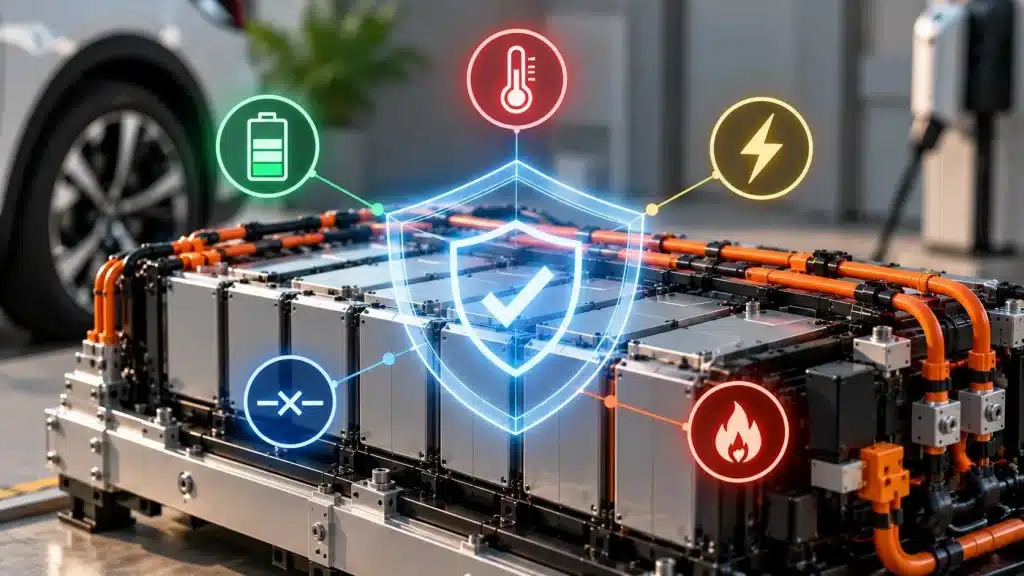
EV batteries must operate safely in various environments.
- High loads, extreme heat, or cold can create risks
- Fault conditions can occur unexpectedly
The BMS must detect issues instantly and take action, such as limiting power or stopping charging, to prevent damage or failure.
Skills Required to Become a BMS Engineer
Understanding how a Battery Management System (BMS) in EVs works is only one part of the journey. Designing and managing such systems requires a combination of knowledge from multiple engineering domains.
A BMS engineer doesn’t work in just one area—they operate at the intersection of electronics, software, battery science, and vehicle systems. This is what makes the role both challenging and highly valuable in the EV industry.
1. Strong Foundation in Battery Fundamentals
Everything in a BMS starts with understanding how batteries behave in real conditions. Engineers need to know how lithium-ion cells respond to charging, discharging, temperature changes, and long-term usage.
This includes concepts like:
- Cell behavior and degradation
- Series and parallel battery pack design
- Charging and discharging characteristics
- Cell balancing and thermal effects
Without this foundation, it’s impossible to design accurate or safe battery systems.
2. Knowledge of Embedded Systems
Since the BMS operates in real time inside a vehicle, it relies heavily on embedded systems. Engineers must understand how hardware and software interact to control battery operations.
This involves:
- Microcontrollers and sensors
- Data acquisition (ADC systems)
- Real-time control logic
- Programming in Embedded C/C++
This is where decisions like “when to stop charging” or “when to limit power” actually get executed.
3. Understanding Battery Estimation Techniques
As discussed earlier, values like SoC and SoH are not directly measured—they are estimated. This makes estimation one of the most complex parts of BMS engineering.
Engineers work with:
- Coulomb counting methods
- Voltage-based estimation
- Battery modeling techniques
- Awareness of Kalman filtering concepts
- Error correction and handling
Accurate estimation directly impacts range prediction and battery reliability.
4. BMS Hardware & High-Voltage Safety
Working with EV batteries means dealing with high-voltage systems, where safety is critical. Engineers must design systems that can monitor and protect the battery under all conditions.
This includes understanding:
- Voltage and current sensing circuits
- Contactors and pre-charge systems
- Insulation monitoring
- Protection logic for fault conditions
Safety is not optional—it is a core responsibility of every BMS engineer.
5. Vehicle Communication Systems
A BMS does not operate in isolation—it constantly communicates with other systems inside the vehicle. Engineers must understand how data flows across different controllers.
Key areas include:
- CAN communication protocols
- Data exchange between BMS and vehicle systems
- Diagnostics and fault reporting
This ensures the entire EV responds correctly based on battery conditions.
6. Thermal Management Understanding
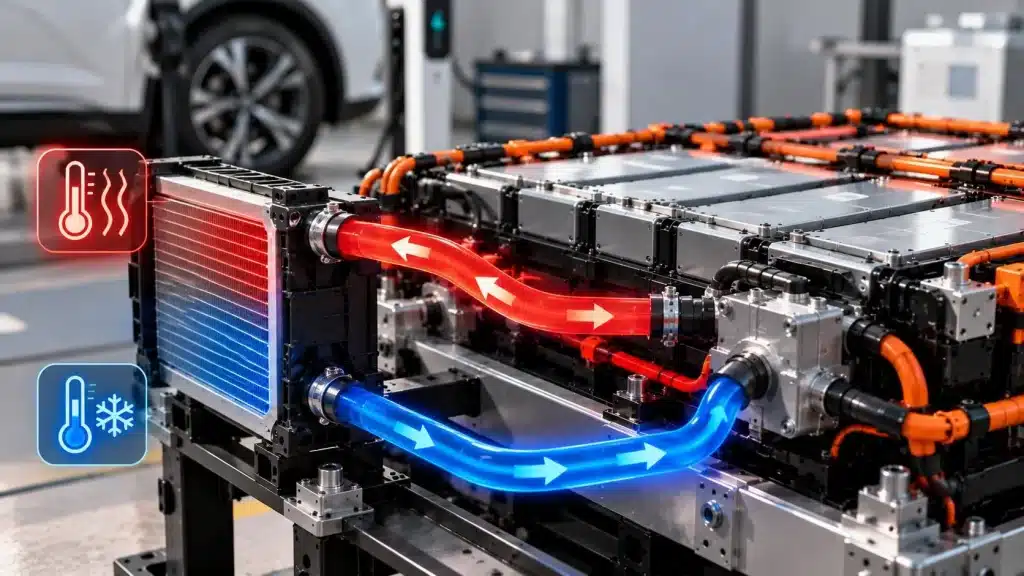
Battery temperature plays a key role in EV performance, safety, and battery life. During charging and driving, heat is continuously generated, and if not managed properly, it can lead to faster degradation, reduced efficiency, and potential safety risks. On the other hand, low temperatures can limit power output and slow down charging.
To handle this, the Battery Management System (BMS) monitors temperature across the battery pack and coordinates with the vehicle’s thermal system to maintain safe operating conditions.
This includes:
- Heat generation during charging and driving
- Cooling and heating methods (air, liquid, battery heaters)
- Temperature variations across cells (thermal gradients)
- Impact on fast charging, performance, and battery aging
- Detection of abnormal temperature rise
Effective thermal management helps improve performance, extend battery life, and ensure safe operation.
Tools Used for Thermal Analysis (Industry Insight)
In real-world EV development, engineers use simulation tools to study battery behavior, thermal performance, and control strategies before physical testing.
Some widely used industry and research tools include:
- MATLAB Simulink & Simscape Battery – supports battery system simulation and the design of BMS control algorithms.
- ANSYS – for detailed heat transfer and cooling analysis
- COMSOL Multiphysics – for advanced electrochemical and thermal simulations
- GT-SUITE – for vehicle-level and battery thermal system modeling
- PyBaMM – for research-focused battery modeling
These tools are used for battery modeling, thermal management design, and BMS development, not directly inside the vehicle’s BMS software.
7. Testing and Validation Skills
Designing a BMS is not enough—it must be tested under real-world conditions. Engineers need to validate performance, safety, and reliability before deployment.
This involves:
- Fault testing and diagnostics
- Hardware-in-the-loop (HIL) testing
- Battery pack validation
- Root cause analysis
This ensures the system performs reliably in all scenarios.
8. Awareness of Safety Standards
Since EV batteries involve high energy systems, engineers must follow strict safety standards while designing BMS solutions.
This includes:
- Concepts from ISO 26262
- Functional safety design principles
- Compliance with EV safety requirements
Safety-driven design is central to BMS development.
Future of Battery Management System (BMS)
As electric vehicles continue to evolve, the Battery Management System (BMS) in EVs is also becoming more advanced. It is no longer just a monitoring system—it is turning into a smart, software-driven intelligence layer that defines how efficiently an EV performs.
In fact, this growing importance is reflected in industry trends—the global Battery Management System market was valued at USD 13.64 billion in 2025 and is projected to reach USD 51.78 billion by 2034, driven by the rapid adoption of electric vehicles and advanced battery technologies.
1. Shift Towards Software-Driven BMS
Modern BMS is moving from hardware-focused systems to software-driven intelligence.
- More decisions are controlled by algorithms
- Over time, updates to the system can refine battery performance and efficiency.
This means future EVs can get better even after purchase
2. Use of AI & Data-Driven Insights
Artificial intelligence is starting to play a role in battery management.
- Predicting battery degradation
- Optimizing charging patterns
- Improving accuracy of SoC and SoH
This helps in making smarter and more precise decisions
3. Connected & Cloud-Based Battery Monitoring
Future BMS systems will not work in isolation.
- Vehicles will share battery data to cloud systems
- Fleet-level insights will improve performance across multiple vehicles
This enables real-time monitoring and predictive maintenance
4. Faster & Smarter Charging Control
Charging technology is evolving rapidly, and BMS plays a key role.
- Better control over ultra-fast charging
- Reduced charging time without damaging the battery
The goal is fast charging with minimal degradation
5. Advanced Battery Technologies Integration
New battery chemistries and designs are emerging.
- Solid-state batteries
- High-voltage architectures (like 800V systems)
BMS will need to adapt to manage these next-gen battery systems
6. Focus on Safety & Sustainability
Future BMS will also focus on:
- Improved safety systems
- Better battery lifecycle management
- Recycling and second-life applications
Supporting sustainable EV growth globally
Conclusion
The Battery Management System (BMS) in EVs is what turns a battery into a reliable power source for real-world driving. It continuously manages safety, performance, charging behavior, and battery life—all in the background.
What makes it important is not just what it does, but how intelligently it does it—constantly adapting to temperature, usage, and battery condition. This is what allows modern EVs to deliver consistent performance without compromising safety.
As electric vehicles evolve, BMS is becoming more software-driven and more critical than ever. For anyone looking to understand EV technology or build a career in this space, BMS is one of the most important areas to start with.
Explore the EV Battery Management System (BMS) Certification Program by Tata Technologies
Build a deeper understanding of how modern EV battery systems are designed, monitored, and optimized — with a focus on real-world applications and system-level thinking.
Explore ProgramContact UsFAQs
A Battery Management System (BMS) is an electronic system that monitors and controls an EV battery. It ensures safe operation by managing charge, temperature, and overall battery health.
A BMS tracks voltage, current, and temperature while controlling charging, balancing cells, and preventing unsafe conditions like overheating or overcharging.
The BMS protects the battery from damage and ensures safe, efficient performance. Without it, the battery could overheat, degrade quickly, or fail.
A BMS works using a sense–think–act approach—it collects battery data, processes it using algorithms, and takes actions like limiting power or controlling charging.
SoC (State of Charge) shows the current battery level, while SoH (State of Health) indicates how much the battery has aged and its remaining capacity.
Charging slows down because the BMS reduces current to prevent overheating and protect battery life as it approaches full capacity.
Cell balancing ensures all battery cells maintain equal charge levels, improving safety, efficiency, and overall battery lifespan.
No, EVs cannot operate safely without a BMS. It is essential for monitoring, protection, and proper battery management.
If the BMS fails, the battery may overheat, degrade faster, or give incorrect readings, leading to reduced performance or safety risks.
You can learn BMS by understanding battery fundamentals, system architecture, and real-world EV applications through structured courses and hands-on practice.
Yes, i GET IT offers a dedicated Battery Management System (BMS) module as part of its EV learning programs. It covers key concepts like battery monitoring, SoC/SoH estimation, cell balancing, and protection strategies through structured, industry-focused learning.

Prateek Potnis
Related Posts

Sketch Checking in Siemens Designcenter: A Quick Tech Tip

Manufacturing Process Planning: Step-by-Step Guide for Engineers

How to Insert a Sketch Picture in SOLIDWORKS (Step-by-Step Guide)

CATIA V5 Tutorial – How to Use Note Object Attribute with Ditto

Geneva Mechanism Explained: Working Principle, Design & Applications
Find
Categories
Latest Posts

Battery Management System (BMS) in EVs: Working & Functions
October 6, 2026
Sketch Checking in Siemens Designcenter: A Quick Tech Tip
September 30, 2026
Manufacturing Process Planning: Step-by-Step Guide for Engineers
September 10, 2026Popular Tags