

Aircraft Tail Design and Configurations: Types of Empennage Explained
August 13, 2026 2026-08-14 12:04Aircraft Tail Design and Configurations: Types of Empennage Explained
Aircraft Tail Design and Configurations: Types of Empennage Explained
Have you ever noticed how the tail of an aircraft changes from one plane to another? From commercial airliners to fighter jets, aircraft tail designs differ significantly according to each aircraft’s mission and performance requirements. While it may seem like a small structural variation, the aircraft tail—technically known as the empennage—plays a key role in shaping an aircraft’s flight characteristics and response.
In aviation engineering, these design differences are not random. Each aircraft tail configuration is developed based on aerodynamic efficiency, control response, and mission requirements. Whether it is a conventional layout used in commercial aircraft or a more advanced configuration seen in military jets, the empennage reflects a series of carefully considered design choices.
Understanding different aircraft tail designs is not just about identifying shapes—it is about understanding how aircraft achieve balance, respond to pilot inputs, and maintain controlled flight under varying conditions. In this blog, we will explore the key aircraft tail configurations and the engineering logic behind each design.
Table of Contents
What is an Aircraft Tail (Empennage)?
The aircraft tail, or empennage, is the rear section of an aircraft that plays a key role in maintaining stability and control during flight. It includes fixed components such as the horizontal stabilizer and vertical stabilizer, along with movable control surfaces such as the elevator and rudder. In some aircraft, a single movable horizontal-tail surface called a stabilator replaces the separate horizontal stabilizer and elevator, combining their functions.
How the Aircraft Tail Maintains Stability and Control
At its core, the tail works like a balancing system that keeps the aircraft stable throughout the flight. As an aircraft moves through the air, it constantly faces disturbances such as turbulence, airflow variations, and speed changes. The empennage helps counter these forces, ensuring the aircraft maintains its intended direction despite airflow disturbances
This stability is achieved through a combination of aerodynamic surfaces working together. The horizontal stabilizer primarily provides longitudinal stability, while the elevator or stabilator controls pitch—the up and down movement of the aircraft’s nose. Similarly, the vertical stabilizer provides directional (yaw) stability by resisting unwanted rotation of the aircraft’s nose from side to side. Supporting these are control surfaces like the rudder, which allow pilots to make precise directional adjustments during flight.
In simple terms, while the wings generate lift to keep the aircraft in the air, the aircraft tail ensures it stays balanced, stable, and responsive to control inputs. Without this system, maintaining smooth and controlled flight would be extremely challenging.
Types of Aircraft Tail Designs
Once we understand how the aircraft tail contributes to stability and control, the next question is—why do different aircraft have different tail designs?The answer lies in the aircraft’s engineering requirements. Every aircraft is designed for a specific purpose, whether commercial transport, military operations, or lightweight aviation. As a result, engineers select different tail layouts to meet the aircraft’s performance, aerodynamic, and structural needs.
While there are several variations used in the aviation industry, some configurations are more commonly seen due to their efficiency and reliability. Each empennage design in aircraft represents a balance between stability, control, weight, and operational requirements.
In the following sections, we will explore the most widely used airplane tail types, along with their working principles, advantages, and limitations.
1. Conventional Tail (Standard Tail)
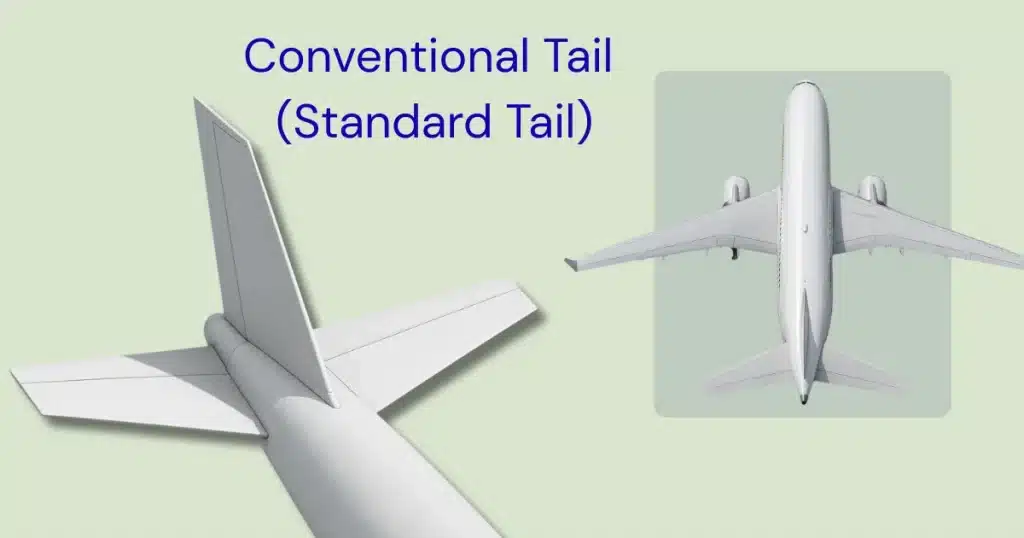
The conventional tail, also known as the standard tail, is the most widely used aircraft tail design in aviation. It features a single vertical stabilizer with the horizontal stabilizer mounted at its base, forming a simple and well-balanced structure at the rear of the aircraft.
Why it works:
This configuration is aerodynamically efficient and operates in relatively stable airflow. As a result, control surfaces like the rudder and elevator provide consistent and dependable response across different flight conditions.
Where it is used:
The conventional tail is commonly found in aircraft such as the Boeing 737, Airbus A320, and Cessna 172. It is the default choice for most commercial and general aviation aircraft due to its proven performance and simplicity.
Trade-offs:
Despite its advantages, this design can be affected by airflow disturbances from the wings at higher angles of attack. Its main limitation is that the horizontal stabilizer may experience disturbed airflow from the fuselage, wing, propeller, or engine installation under certain flight conditions.
2. T-Tail Configuration
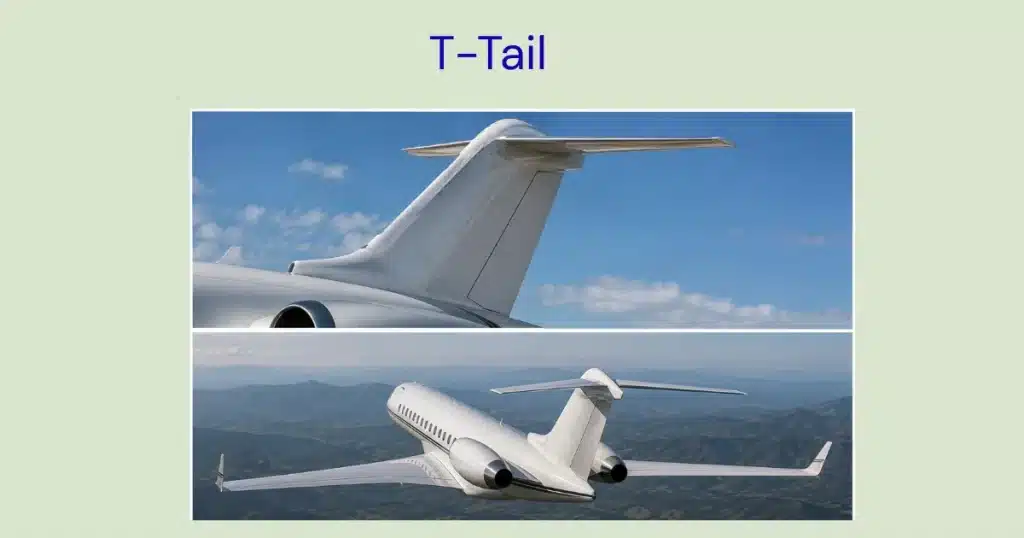
The T-tail is a distinctive aircraft tail design where the horizontal stabilizer is mounted on top of the vertical stabilizer, forming a “T” shape. This configuration places the tail surfaces higher above the fuselage compared to a conventional tail.
Why it works:
One of the key advantages of the T-tail is that its elevated horizontal stabilizer can avoid some of the disturbed airflow generated by the wing, fuselage, propellers, or engines, depending on the aircraft configuration and flight conditions. This helps improve elevator effectiveness, enabling more consistent pitch control, especially at higher speeds.
Where it is used:
T-tail configurations are commonly found in business jets, regional aircraft, and some military aircraft. Examples include the Bombardier CRJ series and certain tri-jet aircraft, where engine placement at the rear fuselage requires the tail to be positioned higher.
Trade-offs:
Despite its aerodynamic benefits, the T-tail has a critical limitation known as deep stall. At very high angles of attack, the stalled wing and fuselage can generate a turbulent wake that blankets the horizontal stabilizer and elevator. This can significantly reduce pitch-control authority and make stall recovery more difficult. Additionally, this configuration is structurally more complex and heavier than a conventional empennage.
3. V-Tail Configuration
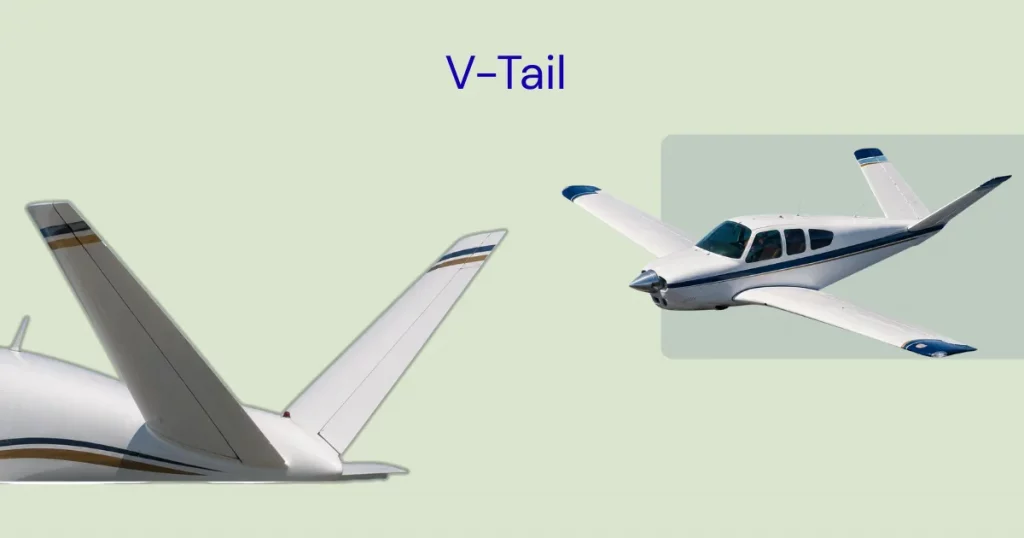
The V-tail is a unique aircraft tail design where the traditional vertical and horizontal stabilizers are replaced by two inclined surfaces arranged in a “V” shape. Instead of separate control surfaces, this configuration uses a combined system known as ruddervators, which perform the functions of both the rudder and elevator.
Why it works:
By combining the functions of the horizontal and vertical tail surfaces, a V-tail may reduce wetted area or structural weight in some designs, depending on the aircraft configuration. It can also potentially reduce drag, although control-system complexity and aerodynamic interference can offset some of the expected benefits.
Where it is used:
V-tail configurations are commonly found in lightweight aircraft, drones, and unmanned aerial vehicles (UAVs). It is also used in some experimental and glider aircraft where reducing weight and drag is a priority.
Trade-offs:
While the V-tail can offer advantages in weight and drag reduction, it introduces complexity in control systems. The combined rudder and elevator functions require precise control inputs and can be more difficult to design and maintain. In some cases, this can affect overall control response under demanding flight conditions.
4. Twin-Tail Configuration
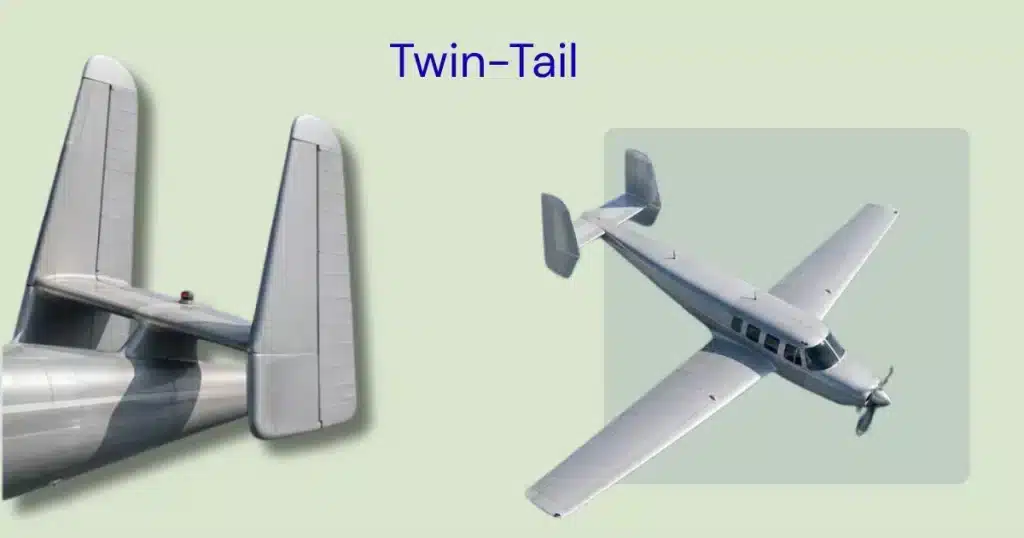
The twin-tail is an advanced aircraft tail design that features two vertical stabilizers instead of one, typically mounted on either side of the horizontal stabilizer. This configuration is commonly used in high-performance and military aircraft.
Why it works:
By dividing the vertical stabilizing area between two fins, the twin-tail configuration can reduce the height of each vertical fin and provide useful directional-control authority in certain high-angle-of-attack conditions, depending on fin size, position, and airflow. In some military aircraft, canted twin tails can help manage radar cross-section, but this feature alone does not make an aircraft stealthy.
Where it is used:
Twin-tail configurations are widely seen in fighter jets and military aircraft such as the F/A-18 and F-22. These aircraft require high maneuverability and stability under demanding flight conditions, which makes this aircraft tail configuration effective.
Trade-offs:
The twin-tail design increases structural complexity and weight compared to a conventional empennage. It also requires more maintenance due to additional components. While it can offer advantages in demanding flight conditions, it is generally less common in commercial aircraft, where simplicity and cost-efficiency are priorities.
5. Cruciform Tail Configuration
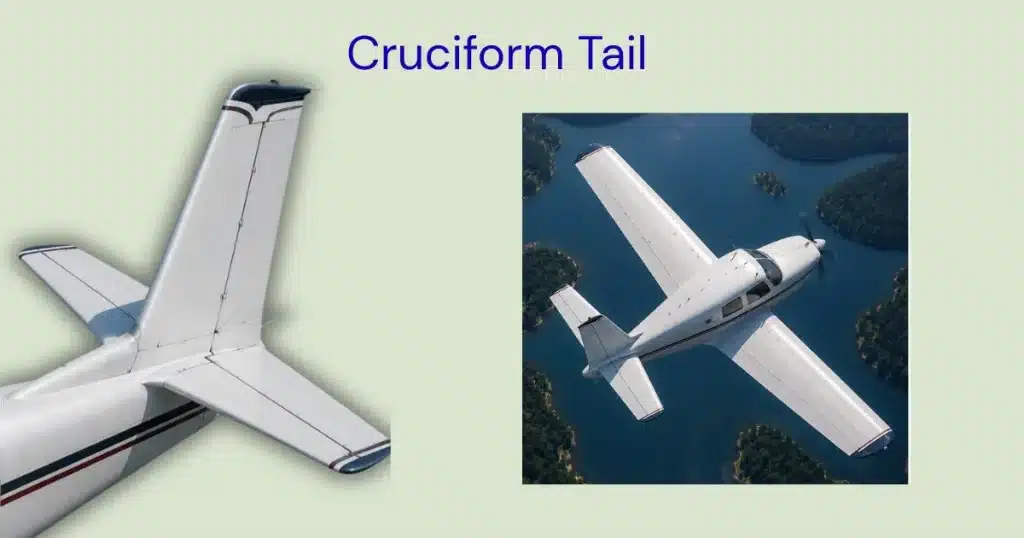
The cruciform tail is a less common but highly effective aircraft tail configuration where the horizontal stabilizer is mounted midway up the vertical stabilizer, forming a cross-like (“cruciform”) shape. This design sits between the conventional tail and T-tail in terms of positioning.
Why it works:
The cruciform tail is designed to keep the horizontal stabilizer partially above the disturbed airflow from the wings while avoiding the full structural complexity of a T-tail. This allows for improved control effectiveness and more stable airflow over the tail surfaces during different flight conditions.
Where it is used:
This configuration is commonly found in certain military aircraft, cargo aircraft, and some regional planes. It is particularly useful in aircraft where maintaining control authority in varied airflow conditions is important.
Trade-offs:
While the cruciform tail offers a balance between performance and stability, it still introduces additional structural complexity compared to a conventional empennage. It is also less commonly used, which means fewer standard design advantages compared to more widely adopted configurations.
Other Tail Arrangements and Alternative Aircraft Configurations
In addition to the commonly used designs, there are several other aircraft tail configurations used for specialized applications. While they are less common, they still play an important role in specific aircraft designs.
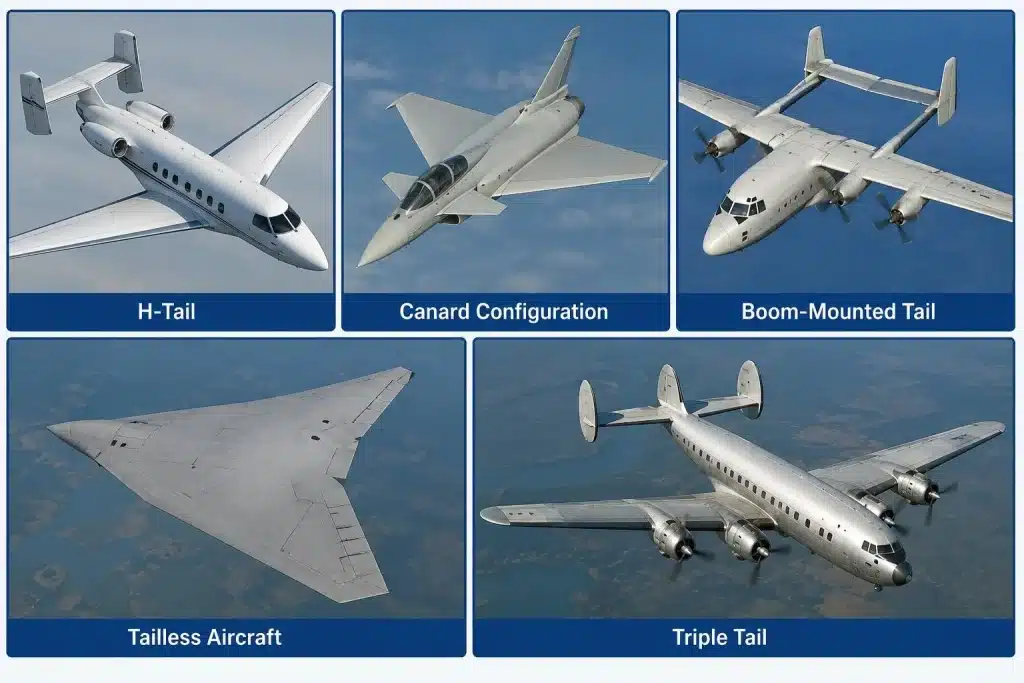
H-Tail:
This aircraft tail configuration features two vertical stabilizers connected by a horizontal stabilizer, forming an “H” shape. This arrangement can provide adequate directional-control area while allowing flexibility in the placement and size of the vertical stabilizers, depending on the aircraft design.
Canard Configuration:
In this design, small horizontal control surfaces are placed near the front of the aircraft instead of the rear. Although it is not part of the traditional empennage, it significantly influences aircraft balance, lift distribution, and overall control behavior.
Boom-Mounted Tail: This aircraft tail configuration places the empennage on one or two extended structures, or booms, that originate from the wings or central fuselage. This arrangement can provide space for rear loading ramps, pusher propellers, engine installations, or unobstructed access to the central fuselage, depending on the aircraft design.
Tailless Aircraft:
In certain modern and advanced aircraft, the traditional vertical and horizontal tail surfaces are minimized or eliminated. Stability and control are achieved through a combination of wing design, aerodynamic shaping, control surfaces such as elevons, and, in some cases, advanced flight-control systems.
Triple Tail:
The triple tail configuration consists of three vertical stabilizers mounted at the rear of the aircraft. This design was mainly used in early large aircraft to provide adequate directional stability while keeping the overall tail height within operational limits. Although effective for its time, it is rarely used in modern aviation due to increased structural complexity and advancements in single-fin designs.
Accurate aircraft components rely on clear design specifications and manufacturing controls such as GD&T. Learn more in our guide: what is GD&T and why it is important for design engineers.
How Engineers Choose Between Aircraft Tail Types
The choice of an aircraft tail design is never random—it results from balancing multiple engineering factors to meet specific performance and operational requirements. Different aircraft tail configurations are selected based on how effectively they support the aircraft’s intended function.
Mission Requirements:
The purpose of the aircraft plays a key role in tail selection. For example, commercial aircraft prioritize efficiency and predictable performance, making conventional tails a common choice, while military aircraft may use twin-tail designs to support maneuverability under demanding flight conditions.
Engine Placement:
The position of engines significantly affects empennage design in aircraft. Aircraft with rear-mounted engines often use T-tail configurations to position the horizontal stabilizer above the engine exhaust and wake.
Aerodynamic and Stall Behavior:
Each tail design responds differently under extreme conditions. For instance, T-tail aircraft require careful design considerations to avoid deep stall. In contrast, conventional tails can offer predictable aerodynamic behavior, although stability depends on the overall aircraft design rather than the tail configuration alone.
Radar Visibility:
In modern military aircraft, tail design can also play a role in radar cross-section management. Features such as canted tail surfaces, aligned edges, blended geometry, and tailless configurations may contribute to reducing radar cross-section when integrated into a complete low-observable aircraft design.
Structural Complexity and Cost:
Advanced tail configurations can improve performance but also increase manufacturing complexity, certification challenges, and maintenance costs.
Operational Constraints:
Practical considerations such as hangar space and aircraft height also influence design decisions. In some cases, engineers must adjust tail configurations to meet physical storage and operational limitations. In essence, selecting the right empennage is about balancing performance, efficiency, safety, and practicality—ensuring the aircraft performs optimally in its intended role.
If you’re interested in aviation careers, explore our blog on how to become an aerospace engineer – job requirements & tips.
Aircraft Tail Configurations: Key Differences and Trade-offs
| Tail Configuration | Main Characteristic | Typical Advantage | Main Limitation |
|---|---|---|---|
|
Conventional Tail |
Horizontal stabilizer mounted low on the fuselage |
Simple, reliable, and widely used |
May be affected by wing or fuselage wake in some conditions |
|
T-Tail |
The horizontal stabilizer is positioned at the top of the vertical fin. |
Can operate in cleaner airflow in some conditions |
Risk of deep stall and higher structural loads |
|
V-Tail |
Two inclined surfaces combine pitch and yaw control functions |
Potentially reduced wetted area and distinctive layout |
Requires complex control mixing and may cause pitch-yaw coupling |
|
Twin-Tail |
Two vertical stabilizers instead of one |
Can provide useful directional-control authority at high angles of attack and reduce the height of each vertical fin |
Increased weight, drag, and structural complexity |
|
Cruciform Tail |
Horizontal stabilizer mounted partway up the vertical fin |
A compromise between conventional and T-tail |
Less common and structurally more complex |
|
Triple Tail |
Three vertical stabilizers |
Provides directional stability while limiting overall tail height |
Adds drag, weight, and structural complexity |
The Future of Aircraft Tail Design
Aircraft tail design is evolving as aviation moves toward more efficient and innovative systems. Engineers are now exploring concepts that go beyond traditional empennage layouts.
1. New Aircraft Shapes:
Concepts like blended wing body (BWB) aircraft—being explored by NASA, Boeing, and Airbus—aim to significantly improve fuel efficiency by rethinking the need for a conventional tail.
2. Electric & Hybrid Aircraft:
As propulsion systems evolve, engine placement is becoming more flexible, directly influencing how the empennage is designed and positioned.
3. Smarter Control Systems:
Modern fly-by-wire technology allows aircraft to maintain controlled flight even with unconventional or minimal tail designs, expanding design possibilities.
4. Advanced Manufacturing:
With technologies like 3D printing, complex tail geometries are becoming easier and more practical to manufacture. Despite these advancements, the tail of an aircraft will always play a critical role in ensuring controlled, efficient, and reliable flight performance.
Conclusion
From the familiar single fin of a Cessna to the elegant triple tail of a Constellation, the many aircraft tail designs reflect over a century of aviation ingenuity. Each aircraft tail configuration is a carefully engineered response to specific aerodynamic, structural, and operational challenges.
Understanding the tail of an aircraft—what it does, why it is shaped the way it is, and the trade-offs it represents—offers deeper insight into the complexity behind smooth and well-managed flight behavior. The empennage is more than just a structural part; it is a vital system that maintains balance, control, and performance throughout all phases of flight.
The next time you see an aircraft flying overhead, take a moment to notice its tail.In its shape and arrangement, you’ll find a story of compromise, innovation, and the continuous pursuit of better, more efficient flight.
Explore the Aerospace Design Engineer Certificate Program by Tata Technologies
Develop industry-relevant skills to design aircraft components using CAD tools, digital twin concepts, and advanced aerospace design techniques through a structured learning program.
Explore Aerospace Design ProgramContact UsFAQs
The aircraft tail, known as the empennage, is the rear section of an aircraft that helps maintain stability, trim, and control during flight. It typically consists of the horizontal stabilizer, vertical stabilizer, elevator, and rudder.
The primary function of the aircraft tail is to provide stability and control. The horizontal tail supports pitch (up and down movement), while the vertical tail maintains directional or yaw stability.
Common aircraft tail designs include the conventional tail, T-tail, V-tail, twin-tail, cruciform tail, H-tail, and triple tail. Canard and tailless layouts are considered alternative aircraft configurations rather than standard rear-tail designs.
A conventional aircraft tail consists of a single vertical stabilizer and a horizontal stabilizer mounted near the base of the fin. It is widely used due to its simple design, reliability, and predictable performance.
A T-tail configuration has the horizontal stabilizer mounted at the top of the vertical stabilizer, forming a “T” shape. This setup can position the tail above some airflow disturbances depending on the aircraft design.
A T-tail can improve pitch-control effectiveness in certain conditions and works well with rear-mounted engines. However, it may involve higher structural loads and can be prone to deep-stall conditions at high angles of attack.
A V-tail aircraft uses two angled surfaces instead of separate horizontal and vertical stabilizers. These surfaces operate using combined control inputs through ruddervators, which manage both pitch and yaw.
Twin tails divide the vertical stabilizing area into two fins, which can help manage airflow and provide useful directional control during demanding flight conditions. In some cases, their orientation may also support radar cross-section management as part of overall aircraft design.
Deep stall occurs when airflow from a stalled wing disrupts the horizontal stabilizer, reducing pitch-control effectiveness. This condition can make stall recovery more difficult and is often associated with certain T-tail designs.
No, a canard is not a traditional tail configuration. It places control surfaces ahead of the main wing and is categorized as an alternative aircraft design rather than part of the empennage.
The aircraft tail is essential for maintaining balance and controlled flight. It helps the aircraft stay stable and respond accurately to pilot inputs and external forces like turbulence.
In tailless aircraft, stability and control are achieved through wing design, control surfaces such as elevons, and sometimes advanced flight-control systems.
A stabilizer is a fixed surface that provides stability, while the elevator is a movable surface attached to it that controls pitch, allowing the aircraft to move its nose up or down.

Sayyam Tholiya
Related Posts

Top Manufacturing Design Courses By Tata Technologies

Best Product Design Courses by Tata Technologies

SOLIDWORKS Certification: Top Courses, Prep Tips & Salaries

Top Automotive Design Engineer Courses by Tata Technologies

PLM Teamcenter Interview Questions and Answers – [HR Expert List]
Find
Categories
Latest Posts


Popular Tags