





Best GD&T Course Guide 2026: Learning Roadmap & Insights
March 19, 2026 2026-04-08 17:07Best GD&T Course Guide 2026: Learning Roadmap & Insights
Best GD&T Course Guide 2026: Learning Roadmap & Insights

Looking for the best GD&T course to Mater practical engineering skills in 2026?
Geometric Dimensioning and Tolerancing (GD&T) plays a crucial role in modern engineering design and manufacturing. As industries shift toward advanced production technologies and digital engineering workflows, professionals need to accurately define and interpret geometric tolerances to ensure parts fit, function, and perform as intended.
Because of this growing demand, both students and working professionals are increasingly exploring GD&T courses to develop practical tolerancing skills used in real manufacturing environments.
In this guide, we cover the key skills, learning roadmap, industry standards, and training options that can help you build strong GD&T expertise and apply it effectively in real-world engineering scenarios.
Table of Contents
Why GD&T Skills Matter More Than Ever in 2026
Today’s manufacturing world demands razor-sharp accuracy and zero confusion. Industries like automotive, aerospace, robotics, electronics, and medical devices depend on technical drawings that spell out exact design goals with crystal clarity.
A tiny mix-up in size specs can trigger part mismatches during assembly, stall entire production lines, or force expensive fixes from scratch. That’s why Geometric Dimensioning and Tolerancing (GD&T) is a game-changer. Think of it as the universal language of engineering blueprints—it standardizes how to specify allowable shape and size variations, so designers, builders, and quality checkers all see the same picture.
Job market stats back this up big time. From 2025 LinkedIn and Glassdoor engineering reports:
A large number of mechanical engineering roles now consider GD&T an essential skill. Engineers with GD&T skills often earn higher salaries compared to those without it.
Studies further reveal that errors in tolerance specs can eat up 5–10% of overall manufacturing expenses, driving firms to pour resources into GD&T workshops and uniform tolerancing protocols.
Source: LinkedIn Jobs & Glassdoor Engineering Skills Reports, 2025.
With GD&T demand surging, students and working engineers alike are hunting for hands-on courses that deliver tolerancing know-how straight from active factories.
Your Roadmap to Mastering GD&T
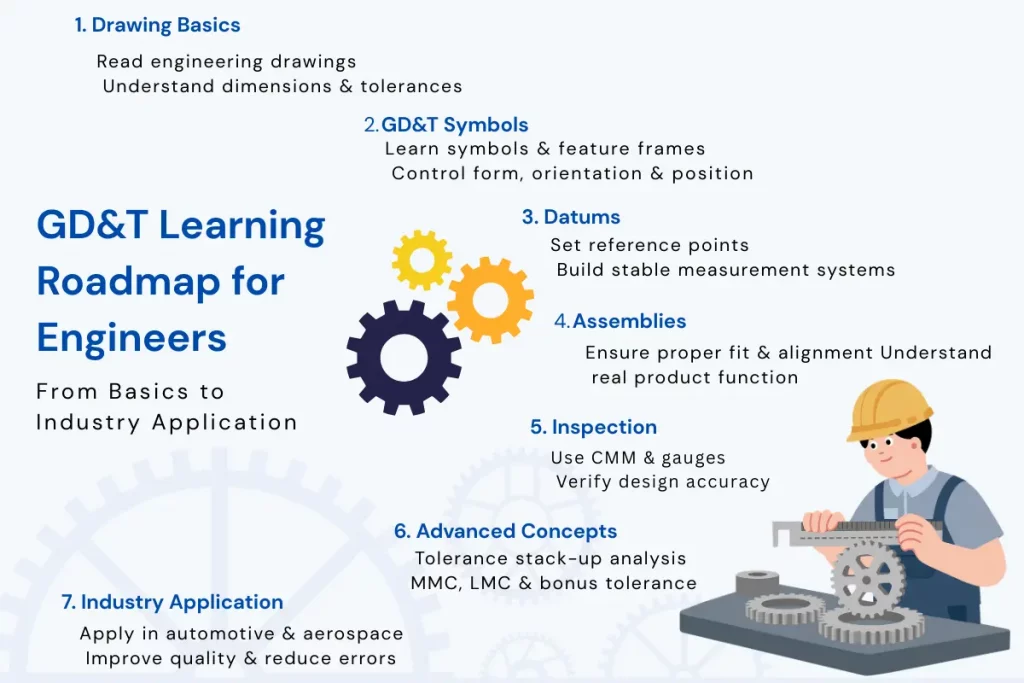
Explore the structured path engineers take to develop expertise in Geometric Dimensioning and Tolerancing (GD&T). Starting with drawing fundamentals and progressing to practical applications, this roadmap outlines the key skills required for achieving precision in engineering.
You may also want to read: What is GD&T and Why is it Important for Design Engineers?
What Engineers Learn in GD&T Courses
A strong GD&T course goes beyond symbol definitions. It helps engineers understand how tolerances affect real components and manufacturing processes.
A strong GD&T course goes beyond symbol definitions. It helps engineers understand how tolerances affect real components and manufacturing processes.
Most training begins with engineering drawing interpretation and dimensional rules.
From there, engineers learn how geometric tolerances control different aspects of part geometry, including:
- form of a feature
- orientation relative to reference surfaces
- location of holes or features
- profile of complex surfaces
- runout of rotating components
These requirements are communicated using feature control frames, which define the tolerance type, tolerance value, and reference datums.
Another key concept is datums and datum reference frames, which provide the measurement foundation used during manufacturing and inspection.
- position tolerance
- flatness and circularity
- orientation controls such as perpendicularity
- profile tolerances for complex surfaces
- Maximum Material Condition (MMC)
- Least Material Condition (LMC)
- datum shift
- tolerance stack-up analysis
These techniques help engineers manage geometric variation in complex assemblies.
Recommended reading: Engineering CAD Drawing Views: Learn Basics, Types & Examples
GD&T Standards Engineers Should Understand
When choosing GD&T training, it is important for engineers to understand the standards that govern tolerancing practices.
ASME Y14.5 Standard
The ASME Y14.5 standard is widely used in North America and many global manufacturing organizations. It defines the rules for applying geometric tolerances in engineering drawings.
Many modern GD&T courses focus on the ASME Y14.5-2018 standard, which clarifies several advanced tolerancing practices.
Industries such as aerospace, automotive manufacturing, and heavy machinery frequently rely on ASME-based GD&T.
ISO GPS Standards
In global supply chains, engineers may also encounter ISO Geometrical Product Specification (GPS) standards.
ISO GPS provides a structured framework for defining geometric tolerances across international manufacturing environments.
Understanding both ASME and ISO tolerancing systems allows engineers to collaborate effectively across global teams.
Top GD&T Online Courses Engineers Explore in 2026
Engineers looking to build GD&T skills often explore different training options based on their learning needs and career goals. While some courses focus on specific topics, others provide a more complete and structured learning experience.
i GETIT by Tata Technologies – GD&T Training Program
The GD&T training available on iGETIT by Tata Technologies is designed as a comprehensive learning solution, covering everything from fundamental concepts to advanced tolerancing techniques within a single platform.
The program includes multiple specialized courses such as:
- Fundamentals of GD&T – ASME Y14.5M-1994
- Fundamentals of GD&T – ASME Y14.5-2009
- Fundamentals of GD&T – ASME Y14.5-2018
- GD&T ASME Y14.5 2009 Update Course
- Advanced GD&T – ASME Y14.5-2009
- Advanced GD&T – ASME Y14.5-2018
These courses are part of a single structured program, allowing engineers to learn GD&T from basic to advanced levels without switching between different platforms. As the entire learning path is included in one subscription, learners don’t need to switch between courses, making it an efficient and budget-friendly way to master GD&T.
CADD Mentors – GD&T Course
Geometric Dimensioning and Tolerancing (GD&T) Course
This course focuses on GD&T fundamentals along with practical training through assignments and projects. It is available in both classroom and online formats and emphasizes hands-on learning.
ASME – GD&T Training
Advanced Geometric Dimensioning and Tolerancing (GD&T) – Y14.5
This course is designed for engineers who want to build advanced knowledge of GD&T based on ASME standards, focusing on geometric controls and their application in engineering drawings.
LinkedIn Learning – GD&T Course
Introduction to Geometric Dimensioning and Tolerancing
LinkedIn Learning offers short courses that introduce GD&T basics such as symbols, rules, and their use in engineering drawings, making them suitable for beginners.
Udemy – GD&T Courses
Geometric Dimensioning and Tolerancing (GD&T) Courses
Udemy features several GD&T courses focused on beginner-level topics like symbols, tolerances, and understanding technical drawings, making them suitable for those who want to learn at their own pace.
GD&T Explained with Short Video Lessons

To help engineers understand GD&T concepts more easily, we have also created a YouTube playlist covering key GD&T symbols and tolerancing concepts.
Each video explains a specific concept such as Straightness, Cylindricity, Position tolerance, Orientation controls, and Profile tolerances using simple examples.
Types of GD&T Courses Engineers Should Consider
When engineers search for top GD&T courses, they usually look for programs that cover both foundational knowledge and advanced engineering applications.
Most GD&T training programs fall into several categories
GD&T Fundamentals Courses
These courses introduce the core principles of geometric dimensioning and tolerancing.
Typical topics include:
- engineering drawing interpretation
- GD&T symbols and feature control frames
- datums and datum reference frames
- form and orientation tolerances
These courses help beginners understand the language of GD&T used in manufacturing.
GD&T Applications Courses
Application-focused training teaches engineers how tolerances affect real product designs.
Topics often include:
- position tolerance for holes
- profile tolerances for complex surfaces
- orientation tolerances such as perpendicularity
- runout controls for rotating components
Advanced GD&T Courses
Advanced training introduces more complex tolerancing strategies used in real engineering applications.
Common topics include:
- tolerance stack-up analysis
- maximum material condition and bonus tolerance
- datum shift and functional gauging
These courses are particularly valuable for engineers working in precision manufacturing industries.
GD&T Inspection and Metrology Courses
Some training focuses on inspection methods used to verify geometric tolerances.
Engineers learn how to:
- inspect parts based on GD&T requirements
- interpret inspection reports
- use coordinate measuring machines (CMM)
GD&T in Modern Engineering Workflows

GD&T is no longer confined to 2D drawings, as modern product development integrates tolerancing directly into 3D design workflows.
In today’s design processes, engineers commonly use GD&T within CAD software such as:
- SOLIDWORKS
- Siemens NX
- PTC Creo
- CATIA
These systems facilitate Model-Based Definition (MBD), allowing the 3D model to act as the central reference for engineering data.
Industry research suggests the Model-Based Enterprise market could reach nearly USD 29.94 billion by 2026, driven by digital product definition and connected manufacturing systems.
Because GD&T defines the geometric rules embedded in these models, engineers with GD&T expertise are essential for implementing digital manufacturing workflows.
Key Skills Engineers Develop Through GD&T Training
GD&T training helps engineers develop the skills needed to design and manufacture components more effectively. These skills allow professionals to communicate design requirements clearly and ensure parts meet functional expectations during production.
Some of the core skills gained through GD&T training include:
- Understanding engineering drawings with greater precision, allowing engineers to interpret dimensions, tolerances, and symbols correctly
- Applying geometric tolerances during product design to control how parts behave in real assemblies
- Expressing design intent clearly so manufacturing teams understand how components should be produced
- Reducing design misunderstandings and production errors that occur when tolerances are not properly defined
- Working closely with quality and inspection teams to verify that manufactured parts meet specified tolerances
Developing these capabilities helps engineers improve collaboration across design, manufacturing, and inspection teams, making GD&T expertise highly valuable in modern engineering environments.
GD&T Career Opportunities & Salary Trends in India
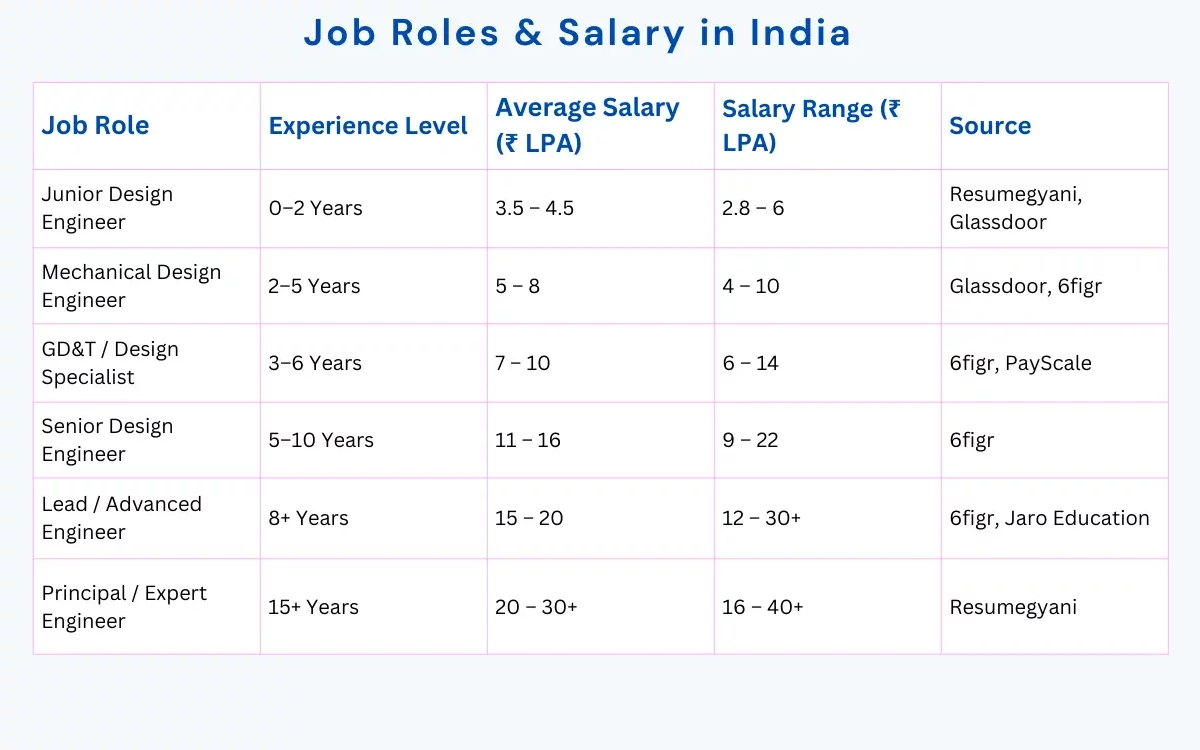
The roles and salary ranges below provide a general overview of how GD&T skills are valued across different engineering positions in India. While opportunities can vary across industries, companies, and individual experience, this snapshot highlights some of the common career paths. The insights are compiled from publicly available data on platforms such as Glassdoor, PayScale, and 6figr for reference.
The Future of GD&T in Smart Manufacturing
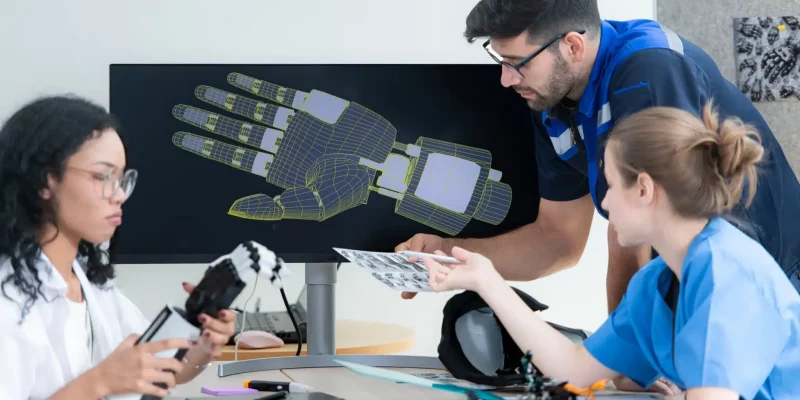
As Industry 4.0 transforms manufacturing, GD&T is expected to remain an essential part of engineering workflows.
Inspection technologies are also advancing rapidly. The global 3D metrology services market is projected to grow from about USD 595 million in 2025 to around USD 855 million by 2032, reflecting the increasing demand for precise measurement of complex components.
Because these inspection systems rely on accurate geometric tolerances, GD&T knowledge becomes essential for engineers working in modern digital manufacturing environments.
Source: Global 3D Metrology Services Market Forecast, 2025–2032.
Conclusion
Geometric Dimensioning and Tolerancing (GD&T) remains a cornerstone skill in today’s engineering landscape, powering advanced manufacturing and digital design shifts. It bridges design, production, and quality teams for unmatched precision, quality, and reliability in every product.
For students or pros aiming to level up, GD&T isn’t just nice-to-have—it’s now baked into core engineering processes.
This guide lays out the essentials, a clear learning roadmap, and top training picks to kickstart or supercharge your skills. Picking a training path that fits your goals can transform how you wield GD&T on the job, turning theory into seamless, real-factory results. A focused program blending basics with pro-level tactics builds real confidence and hands-on mastery, skipping the hassle of scattered resources.
FAQs
GD&T, or Geometric Dimensioning and Tolerancing, is a system used in technical drawings to describe how much variation is allowed in the geometry of a part. It helps engineers specify the exact requirements for shape, orientation, and position so components can be manufactured and assembled correctly.
GD&T allows engineers to clearly define the manufacturing requirements of a component and explain how its geometry should be evaluated during inspection. When tolerances are specified accurately, production teams can manufacture parts more precisely, which helps minimize errors and ensures that components assemble and function correctly.
Beginner GD&T courses usually introduce topics such as interpreting engineering drawings, understanding tolerance symbols, learning feature control frames, and working with datum reference systems. These concepts form the foundation for controlling part geometry in mechanical designs.
Advanced GD&T training often covers topics such as tolerance stack-up analysis, material condition modifiers like MMC and LMC, datum shift concepts, and inspection strategies. These skills help engineers manage dimensional variation in complex designs and precision manufacturing.
GD&T is widely used across engineering industries to ensure products are manufactured with high accuracy. It is widely applied in industries such as automotive design, aerospace engineering, robotics manufacturing, industrial equipment development, and medical device production where precise component alignment is essential.
When selecting GD&T training, engineers should consider courses that explain recognized standards such as ASME Y14.5, include real engineering examples, and provide structured learning modules. Training programs that offer practical exercises and certification can also improve learning outcomes.
Explore the All-in-One MCAD + GD&T Professional Bundle by Tata Technologies
Learn industry-leading CAD tools like SolidWorks, CATIA, Siemens NX, Creo, and Autodesk while also developing essential GD&T skills. Master 3D modeling, design, simulation, and real-world mechanical engineering workflows—all in one comprehensive learning experience.
Explore MCAD BundleContact Us
Sudhanwa Puranik
Related Posts

Manufacturing Process Planning: Step-by-Step Guide for Engineers

How to Insert a Sketch Picture in SOLIDWORKS (Step-by-Step Guide)

Best CATIA Courses Online by Tata Technologies

CATIA V5 Tutorial – How to Use Note Object Attribute with Ditto

Top Siemens NX Online Courses by Tata Technologies
Find
Categories
Latest Posts

Manufacturing Process Planning: Step-by-Step Guide for Engineers
September 10, 2026

Popular Tags