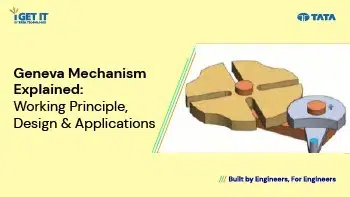
Geneva Mechanism Explained: Working Principle, Design & Applications
March 10, 2026 2026-03-11 14:48Geneva Mechanism Explained: Working Principle, Design & Applications
Geneva Mechanism Explained: Working Principle, Design & Applications
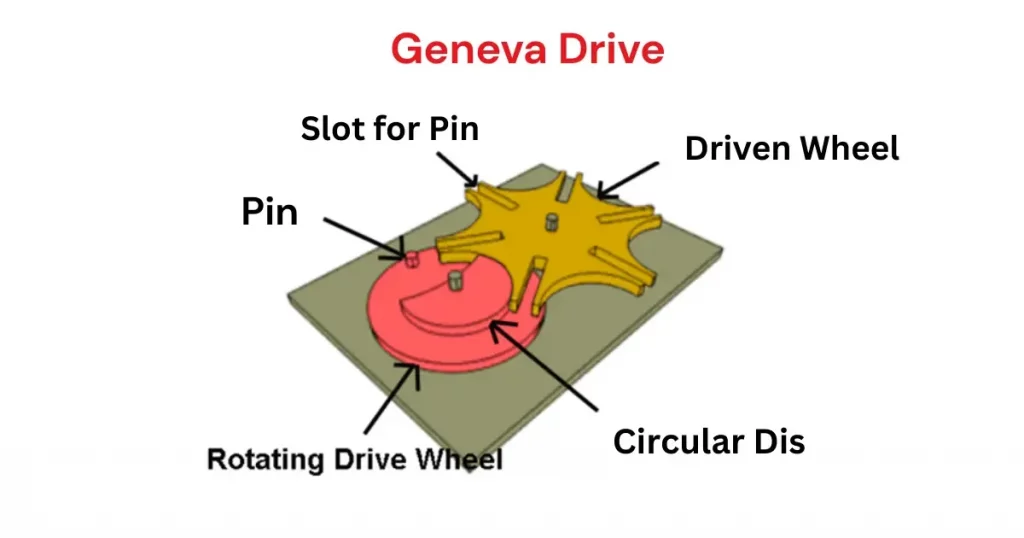
Imagine a machine that needs to move with precision — rotate, stop exactly in position, and then rotate again. This controlled step-by-step motion is made possible by the Geneva mechanism. The Geneva mechanism is a classic mechanical system designed to convert continuous rotation into intermittent motion with defined pauses. Because of its reliability and indexing accuracy, the Geneva mechanism is widely used in automation systems, packaging equipment, and film projection devices. In this blog, we will explore how the Geneva mechanism works, how it is designed, and how it can be modeled for motion visualization.
Table of Contents
What is a Geneva Mechanism?
A Geneva mechanism is a mechanical device that converts continuous rotational motion into intermittent motion. In a Geneva mechanism, a rotating driver wheel with a pin engages with slots in another wheel called the Geneva wheel, causing it to rotate in fixed steps. After each engagement, the Geneva wheel stops for a short period before the next movement, creating precise step-by-step motion.
This controlled indexing motion makes the Geneva mechanism useful in machines that require accurate positioning and repeated pauses between movements.
Common examples include packaging machines, rotary indexing tables, watches, and film projectors.
Key Components That Make Up a Geneva Indexing Mechanism
Driver Wheel (Driving Disk)
A Geneva indexing mechanism consists of several essential components that work together to convert continuous rotational motion into intermittent motion. Each part plays a specific role in producing accurate step-by-step movement.
Driver Pin
The driver pin is mounted on the driver wheel at a specific radial distance from the center. As the driver rotates, the pin enters the slots of the Geneva wheel and pushes it forward, causing the indexing motion.
Geneva Wheel (Driven Wheel)
The Geneva wheel contains multiple radial slots around its circumference. When the driver pin enters one of these slots, the wheel rotates by a fixed angle. The number of slots determines the indexing angle of rotation.
Locking Surface
The driver disk typically includes a circular locking surface that prevents the Geneva wheel from moving when the driver pin is not engaged. This locking action ensures stability and precise positioning during the dwell period.
Types of Geneva Indexing Mechanisms Used in Mechanical Systems
Geneva mechanisms are generally classified into two types based on the location of the slots in the driven wheel.
External Geneva Mechanism
In an external Geneva mechanism, the slots are cut on the outer edge of the Geneva wheel. The driver pin enters these external slots and rotates the wheel intermittently. This type is widely used in industrial machinery due to its simple design and ease of manufacturing.
Internal Geneva Mechanism
In an internal Geneva mechanism, the slots are located on the inner surface of the Geneva wheel. The driver pin engages with these internal slots to produce intermittent motion. Although less common, this design is useful in compact mechanical systems where space constraints exist.
Working Principle: How the Geneva Drive Converts Continuous Rotation into Step-by-Step Motion
The Geneva drive operates through the periodic engagement between the driver pin and the slots of the Geneva wheel. The driver wheel rotates continuously at a constant speed while carrying a pin mounted on its surface.
As the driver rotates, the pin enters one of the slots in the Geneva wheel and pushes it forward, causing the wheel to rotate through a fixed indexing angle. Once the pin exits the slot, the Geneva wheel stops rotating and remains stationary for a short period.
During this dwell phase, the locking surface of the driver wheel prevents any unwanted movement of the Geneva wheel. The cycle repeats when the driver pin engages with the next slot, producing precise step-by-step motion.
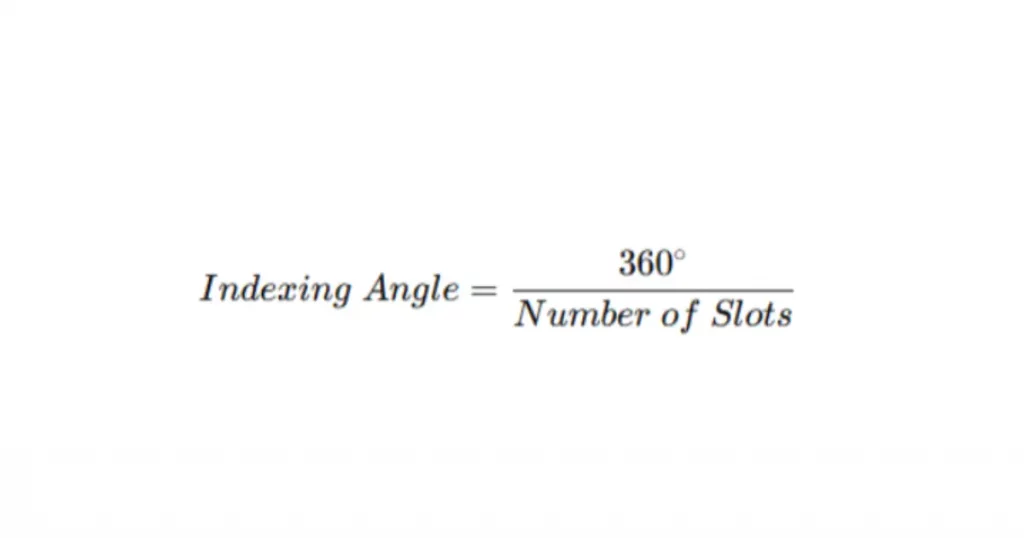
The indexing angle depends on the number of slots in the Geneva wheel. For example, a four-slot wheel rotates 90° per step, while a six-slot wheel rotates 60° per step.
Design Parameters and Calculation of a Geneva Mechanism
The driver wheel is the rotating disk that provides the input motion to the mechanism. It rotates continuously and carries a pin that engages with the slots of the Geneva wheel to transfer motion.
Recommended Reading: Engineering CAD Drawing Views: Learn Basics, Types & Examples
Designing a Geneva mechanism requires careful consideration of several geometric parameters to ensure smooth engagement between the driver pin and the slots of the Geneva wheel. These parameters determine the indexing motion, stability, and overall performance of the mechanism.
One of the most important parameters is the number of slots (Z) in the Geneva wheel. The number of slots determines the indexing angle through which the wheel rotates during each engagement. For example, a Geneva wheel with four slots produces an indexing angle of 90°, while a six-slot wheel produces an indexing angle of 60°.
Another critical parameter is the center distance between the driver wheel and the Geneva wheel. This distance must be properly calculated to ensure that the driver pin enters and exits the slots smoothly without interference.
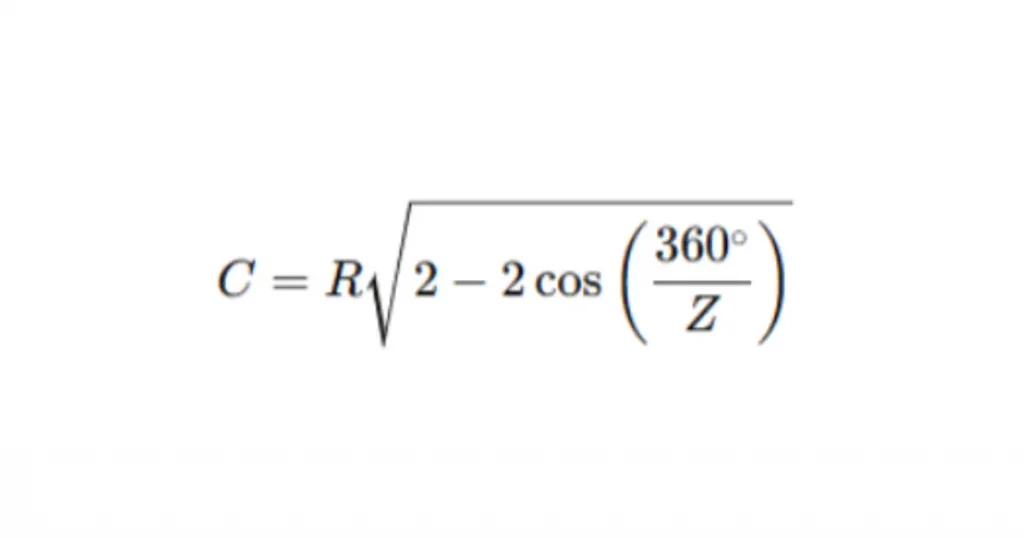
For an external Geneva mechanism, the center distance can be expressed using the relationship:
C = R / sin (180° / Z)
Where:
C = Center distance between the driver and Geneva wheel
R = Pitch circle radius of the Geneva wheel
Z = Number of slots in the Geneva wheel
Other important design parameters include:
Driver disk radius – determines the position of the driving pin
Pin diameter – affects engagement and contact forces
Slot width – should be slightly larger than the pin diameter to allow smooth motion
Locking surface radius – ensures the Geneva wheel remains stationary during the dwell period
Careful selection of these parameters helps reduce wear, improve motion stability, and ensure accurate indexing during operation.
3D Modeling of a Geneva Mechanism in SolidWorks
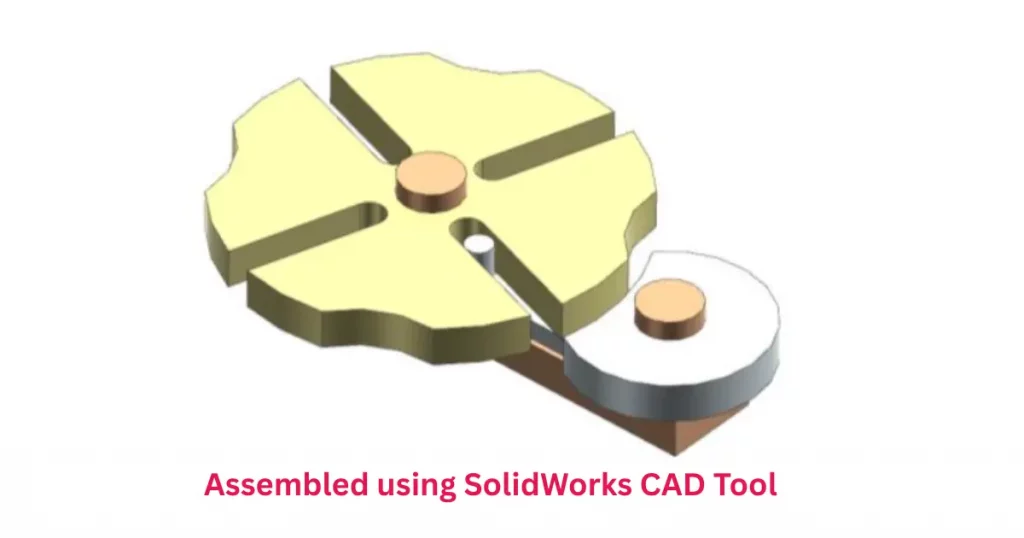
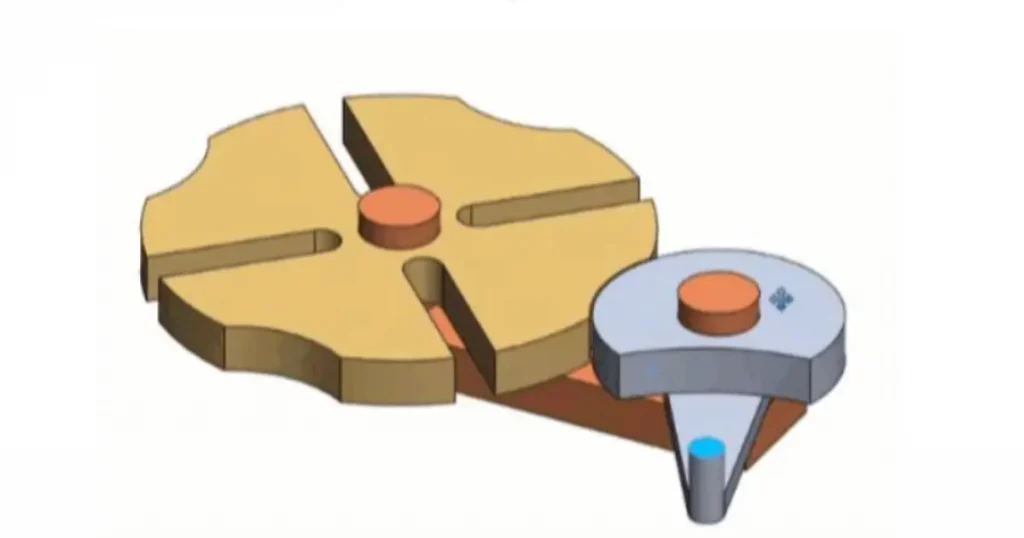
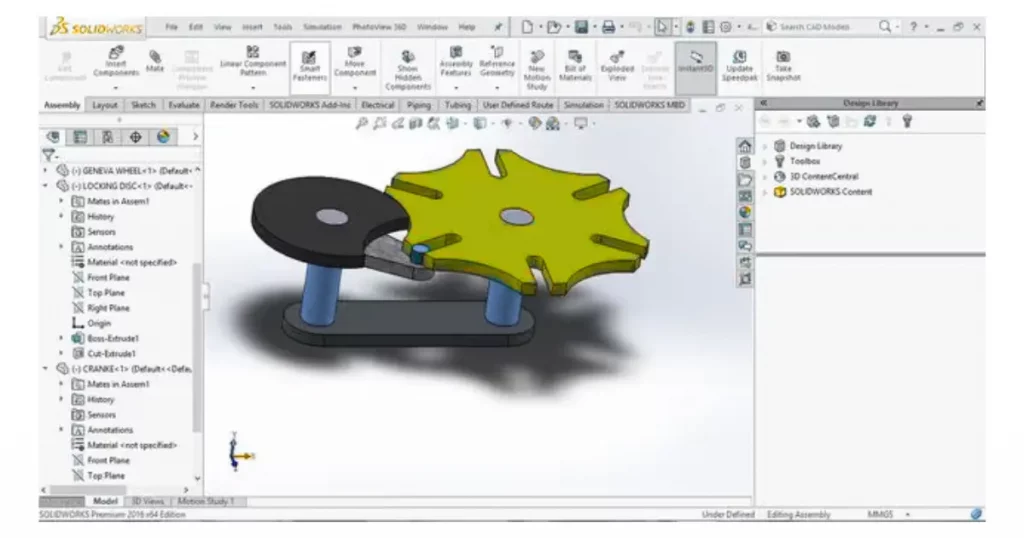
To better understand the motion and working of the Geneva mechanism, it can be modeled and simulated using SolidWorks. Creating a 3D model allows engineers to visualize the intermittent motion and verify the design before manufacturing.
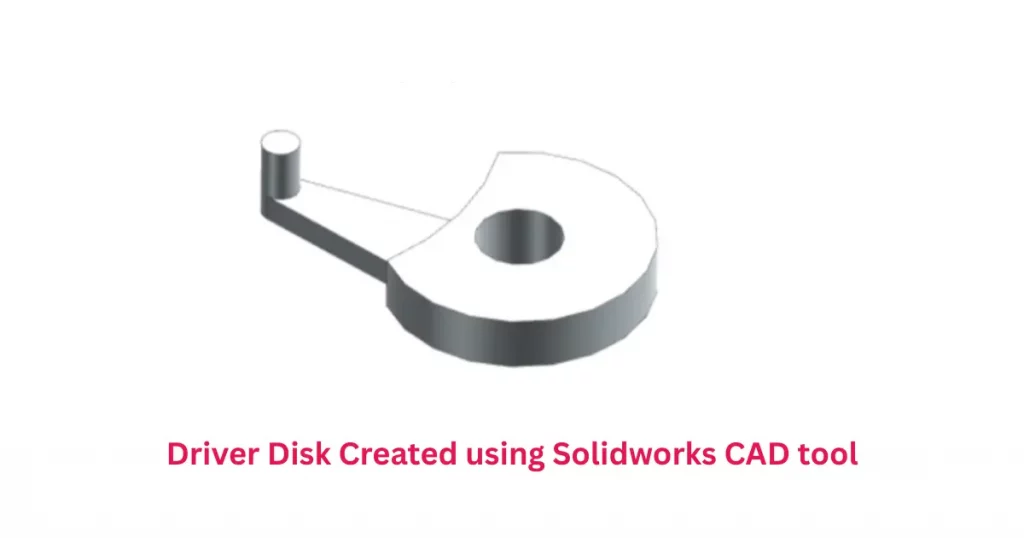
Step 1: Create the Driver Disk
Begin by sketching a circular disk that will act as the driver wheel. A small cylindrical pin is then added at a specific radial distance from the center. This pin will engage with the slots of the Geneva wheel during rotation. The locking arc profile can also be created on the driver disk to restrict unwanted movement.
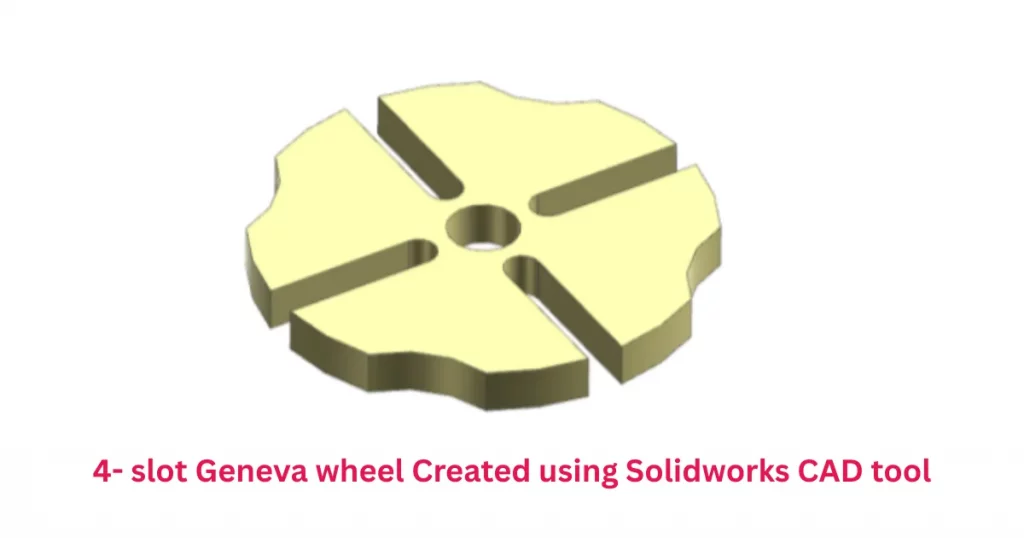
Step 2: Create the Geneva Wheel
Next, create the Geneva wheel by sketching a circular profile. Radial slots are then created on the wheel using the circular pattern feature. The slot width should be slightly larger than the pin diameter to ensure smooth engagement and disengagement.
Step 3: Assembly of Components
In the assembly environment, place both the driver disk and the Geneva wheel at the correct center distance. Apply appropriate mates such as concentric and coincident mates to position the components properly.
Step 4: Motion Study Simulation
A motor can be applied to the driver disk using the motion study feature. When the simulation runs, the driver rotates continuously while the Geneva wheel moves in fixed steps. This simulation clearly demonstrates the intermittent motion and dwell period of the mechanism.
The image and GIF shown here were created using SolidWorks as part of the i GET IT engineering course by Tata Technologies, demonstrating the intermittent indexing motion and dwell phase of the Geneva mechanism.
Motion Characteristics
You May Also Like: Cam and Follower Mechanism – Types, Working & Application
The Geneva mechanism exhibits several unique motion characteristics that make it suitable for precision indexing applications.
One of the most important features is intermittent motion, where the driven wheel moves only when the driver pin engages with a slot. Between engagements, the wheel remains stationary, creating a defined dwell period.
Another characteristic is non-uniform angular velocity. The Geneva wheel accelerates rapidly when the pin enters the slot and decelerates as the pin exits. This results in varying angular velocity during the engagement phase.
Because of these sudden changes in velocity and acceleration, the mechanism may experience higher dynamic forces. Therefore, proper material selection and lubrication are important for high-speed applications.
Advantages and Limitations
Advantages
The Geneva mechanism offers several benefits that make it widely used in mechanical systems:
Simple and compact mechanical design
Precise and repeatable indexing motion
Reliable operation with minimal control systems
Easy to manufacture and maintain
Limitations
Despite its advantages, the mechanism also has certain limitations:
Impact loading occurs when the driver pin engages with the slot
Not suitable for very high-speed applications
Wear may occur at the edges of the slots and the driver pin
To reduce wear and improve durability, engineers often use hardened materials and proper lubrication.
Applications
The Geneva mechanism is widely used in machines that require accurate step-by-step motion and precise positioning.
Common applications include:
Rotary indexing tables used in manufacturing systems
Automatic assembly machines
Packaging machinery
Watchmaking mechanisms
Film projection systems
In these systems, the mechanism ensures that components move to exact positions before the next operation begins.
Real-World Examples of Geneva Mechanism Applications
The Geneva mechanism is widely used in machines that require precise step-by-step motion with controlled pauses between movements. Several real-world mechanical systems use this mechanism to achieve accurate indexing and positioning.
Rotary Indexing Tables in Manufacturing
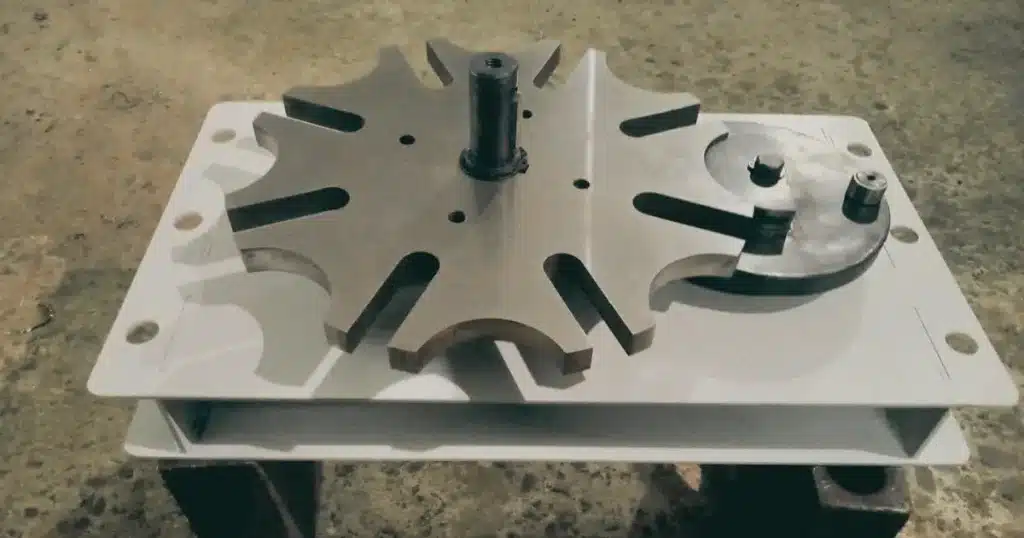
Rotary indexing tables used in automated manufacturing systems often use a Geneva mechanism to rotate components to precise positions. The mechanism allows the table to rotate by a fixed angle and stop temporarily so operations such as drilling, assembly, or inspection can be performed. This controlled indexing helps improve accuracy and efficiency in production lines.
Packaging Machines
Many automated packaging machines rely on the Geneva mechanism to move products step-by-step along the production line. The intermittent motion allows bottles, containers, or packages to stop briefly for processes such as filling, sealing, labeling, or inspection before moving to the next station..
Film Projectors and Motion Picture Systems
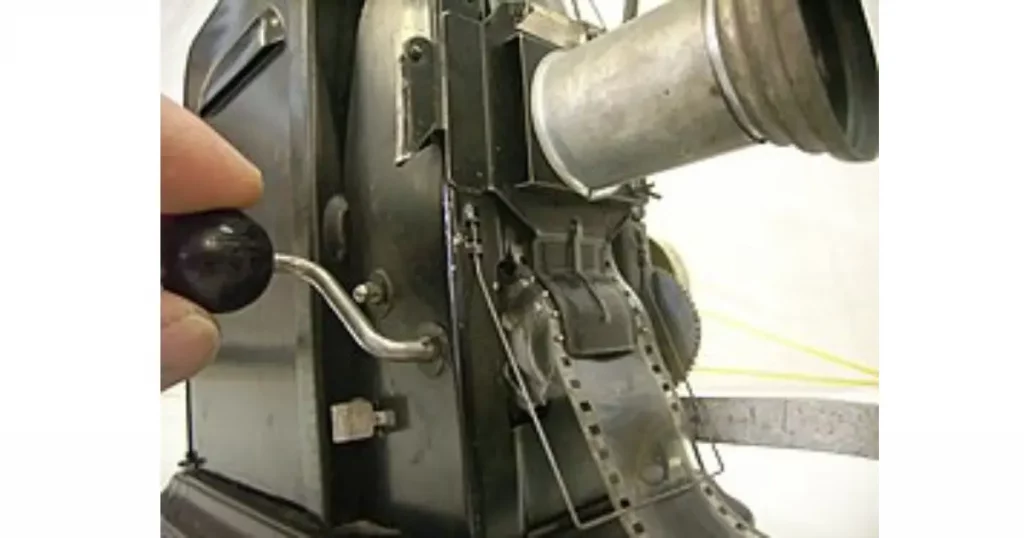
Traditional film projectors also use a Geneva mechanism to move film frames one at a time in front of the projection lens. Each frame pauses briefly so the image can be displayed clearly before the next frame advances. This step-by-step motion was essential for creating smooth motion in early film projection systems.
Conclusion
The Geneva mechanism is an effective mechanical solution for converting continuous rotational motion into precise intermittent motion. Its simple design, reliable operation, and accurate indexing capability make it widely used in automation and mechanical systems.
By understanding the working principle, design parameters, and motion characteristics of the mechanism, engineers can design efficient indexing systems for various industrial applications. Modern CAD tools like SolidWorks also allow engineers to model and simulate the mechanism, helping them analyze motion behavior before physical implementation.
FAQs
A Geneva mechanism converts continuous rotational motion into intermittent step-by-step motion. A rotating driver wheel with a pin periodically enters the slots of the Geneva wheel, causing it to rotate by a fixed angle. Once the pin exits the slot, the wheel remains stationary until the next engagement.
The indexing angle depends on the number of slots in the Geneva wheel. Each time the driver pin enters a slot, the wheel rotates by a fixed angle. For example, a four-slot Geneva wheel produces a 90° rotation, while a six-slot wheel produces a 60° rotation.
The Geneva mechanism is commonly used in packaging machines, rotary indexing tables, film projectors, watchmaking systems, and automated assembly machines where components must move to precise positions with controlled pauses between movements.
The main components include the driver wheel, driver pin, Geneva wheel, and locking surface. The driver wheel rotates continuously while the pin engages with the slots of the Geneva wheel to produce intermittent motion.
The locking surface prevents the Geneva wheel from rotating when the driver pin is not engaged with a slot. This ensures stable positioning and accurate indexing during the dwell period.
There are two main types: external Geneva mechanism and internal Geneva mechanism. In the external type, slots are located on the outer edge of the wheel, while in the internal type the slots are located inside the wheel.
Intermittent motion occurs because the Geneva wheel only moves when the driver pin enters a slot. Between engagements, the wheel remains stationary due to the locking mechanism, creating a move–stop motion cycle.
The Geneva mechanism offers precise indexing, simple mechanical design, reliable operation, and accurate positioning. These advantages make it useful in automation and manufacturing systems.
The Geneva mechanism may experience impact loading when the pin engages with the slot, which can cause wear. It is also not ideal for very high-speed operations due to sudden acceleration and deceleration.
A Geneva mechanism can be modeled in SolidWorks by creating the driver disk and Geneva wheel, assembling them with the correct center distance, and applying a motion study. This simulation helps visualize the intermittent indexing motion before manufacturing.
Explore the All-in-One MCAD Professional Bundle by Tata Technologies
Learn industry-leading CAD tools like SolidWorks, CATIA, Siemens NX, Creo, and Autodesk while mastering 3D modeling, design, simulation, and real-world mechanical engineering workflows.
Explore MCAD BundleContact UsMegharaj
Related Posts
What is Fluid Mechanics? – Introduction, Laws & Equations
What Is AutoCAD Software? Uses, Features & Practical Examples
Independent Front Wheel Suspension – Types, Benefits & Working
What is PLM? – Product Lifecycle Management [Detailed Guide]
Lead-Acid vs. Lithium-Ion Batteries: Key Differences & Best Uses
Find
Categories
Latest Posts
What is Fluid Mechanics? – Introduction, Laws & Equations
January 7, 2026What Is AutoCAD Software? Uses, Features & Practical Examples
December 18, 2025Popular Tags